Commercial flood barriers for business premises
Offices, warehouses, depots, plant rooms and process sites. A deployable steel barrier goes up before the water arrives, comes down afterwards, and leaves nothing behind in your yard. No fill material, no ground fixings, no permanent structure across your access.
-
0.41–2.45 mProtection height across three series
-
100 mBuilt in 30 to 130 minutes by six people
-
FM ApprovedIndustrial and Heavy Duty, PR453294
-
30 yearsIn the field, in 24 countries
The water is the smaller loss
Most businesses that flood do not fail because of the water damage. They fail because of the weeks afterwards.
A flooded warehouse is not a cleaning job. Stock is written off, racking is condemned, the floor has to dry before anything can be put back on it, and the insurer wants a loss adjuster on site before any of that starts. For a distribution site, the cost of being closed usually passes the cost of the damage within the first week.
The same arithmetic runs through an office with a basement plant room, a data hall with switchgear at ground level, a food site that cannot restart without a clean-down certificate, or a workshop whose machines sat in water for a day.
That is the case for protection that is already on site when the warning comes — not ordered when it comes.
- Business interruption is usually the larger claim, and the one with the longest tail.
- Insurance renewals get harder after a loss. Demonstrable protection is a conversation you can have with an underwriter.
- Contractual obligations do not pause. Service levels, delivery windows and tenancy agreements carry on.
- Reinstatement takes longer than drying out. Electrical testing, flooring, calibration.
Three questions decide what you need
You do not have to know which product to ask for. You do have to know these three things, and a site survey establishes all of them in one visit.
How high does the water get?
Not how high it could theoretically get — how high it has got, or what the modelling says for your postcode. This single number decides which series fits, and everything else follows from it. Half a metre and two metres are different products, not different sizes of the same one.
Where does the line run?
Around the whole site, across the yard entrance, or in front of one elevation. Length sets the cost and the build time. Corners, gateways, loading bays and changes of surface set the detailing, and they are where deployments go wrong.
Who puts it up, and how long have they got?
Your own staff, a facilities contractor, or a standby crew. With six people, a hundred metres takes between half an hour and a little over two, depending on the series. Against your flood warning lead time, that is the number that decides whether the plan is real.
A site survey answers all three and is free of charge. It is a survey and a written recommendation, not a sales visit.
Height decides the series
Three series cover 0.41 to 2.45 metres. They share the same principle — a steel panel held by a frame, sealed by a membrane, anchored by the weight of the water itself — and differ in how much water they hold back.
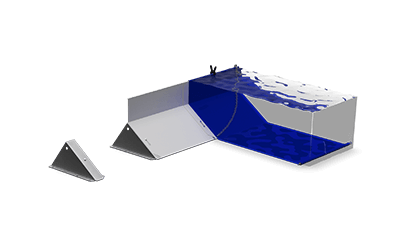
Elemental
The lightest series, and the fastest. Suits shallow surface water, a single elevation, a doorway run or a small yard. Ten kilograms a section — one person can carry and place it.
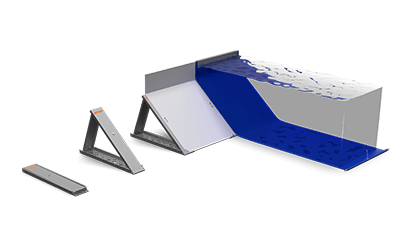
Industrial
Where most commercial sites land. Scales across a long perimeter, handles corners and gateways, and stays light enough for a small team. This is the series behind the 1,400-metre line that protected Cologne.
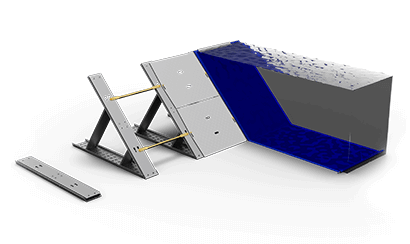
Heavy Duty
For severe events and for sites that cannot be allowed to stop — substations, treatment works, data halls, process plant. Heavier sections, more people, and a protection height nothing else in the range reaches.
Not sure which applies? That is what the site survey is for — and it is the same visit whichever series turns out to fit.
What a commercial site asks of a barrier
A business park is not a riverbank. The things that make a commercial deployment difficult are almost never the water — they are the site.
The line has to cross your access
Yard gates, loading bays and vehicle entrances are the reason most perimeters are left unprotected. A deployable barrier closes them when it matters and leaves them clear the rest of the year. A permanent wall cannot.
The ground is already finished
Asphalt, concrete, block paving, drainage channels. The system is free-standing and self-anchoring, so nothing is bolted, drilled or cast into your surfacing. Nothing has to be made good afterwards either.
Services run underneath it
Surface water drains, foul sewers, ducts and process pipework cross the line whether you can see them or not, and they carry water in under pressure. Closing them off is its own work stream, planned separately from the build.
How to handle services under the lineIt has to be stored somewhere
Components stack on pallets or in stillages between events. A hundred metres of Elemental occupies a couple of cubic metres. Heavy Duty needs more. Storage is part of the plan, not an afterthought.
Your own people put it up
No tools, no machinery, no specialist contractor on standby. That matters at two in the morning when the contractor is three counties away and the warning came four hours ago.
It has to work more than once
Steel components are reused season after season. The consumable is the membrane, not the barrier. Sites in this country have deployed the same stock across a decade of events.
Four steps, no tools
The build is the same whichever series you use. It is the reason a facilities team can be trained on it in an afternoon.
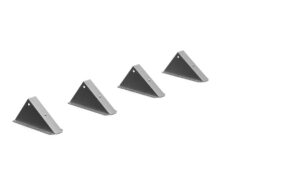
Place and lock the supports
The frames are set out along the line and locked to each other. Spacing is fixed by the components, so the line cannot be built wrong.
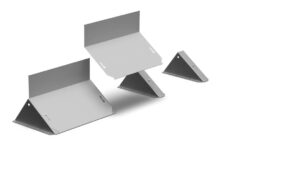
Mount the steel panels
Panels drop onto the frames. An Elemental section weighs 10 to 14 kilograms; the heavier series weigh more, and are planned for more people rather than for machinery.
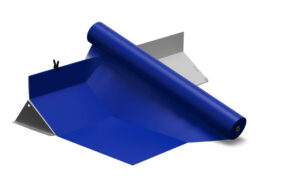
Lay the membrane
The membrane runs over the face and out along the ground on the water side. It is what seals the line to your surfacing.
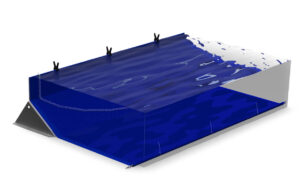
The water anchors it
Rising water presses down on the membrane apron. The heavier the load, the harder the barrier is held to the ground. Nothing is fixed into your surface.
Against sandbags, at commercial scale
Sandbags work. They just do not scale to a perimeter, and they cost you the thing you have least of during a flood warning: people and hours.
Sandbags
- Filled and placed by hand, bag by bag
- Material has to be delivered, filled, placed and then taken away as waste
- Needs a loader and a lorry to move and to take away
- Single use. Contaminated bags are waste after the event
- Seals poorly against a flat surface and settles as it wets
- No certification behind it
Geodesign barriers
- Carried and placed by hand, no machinery on site
- A hundred metres by six people in 30 to 130 minutes, depending on series
- Stored flat on your own site between events
- Reused season after season. The membrane is the consumable
- Seals to asphalt, concrete and block paving through the membrane apron
- Industrial and Heavy Duty carry FM Approval, Approval Identification PR453294, to ANSI/FM 2510-2020
Where sandbags still win: a handful of bags at one doorway, bought the same afternoon. This is a comparison about perimeters, not about doorsteps.
Businesses that stayed open
Three deployments where the site was operational infrastructure, not a street.
-
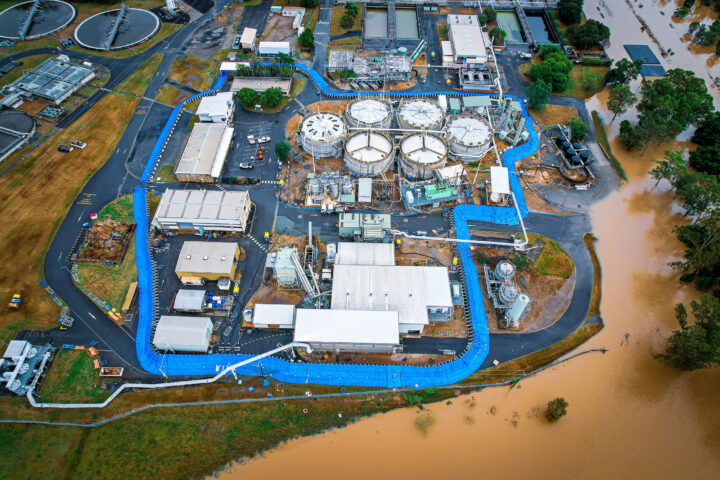
Oxley Creek treatment plant
Six hundred metres of Heavy Duty barrier around a wastewater treatment works during ex-Tropical Cyclone Alfred. The plant kept running while the ground around it was under water.
-
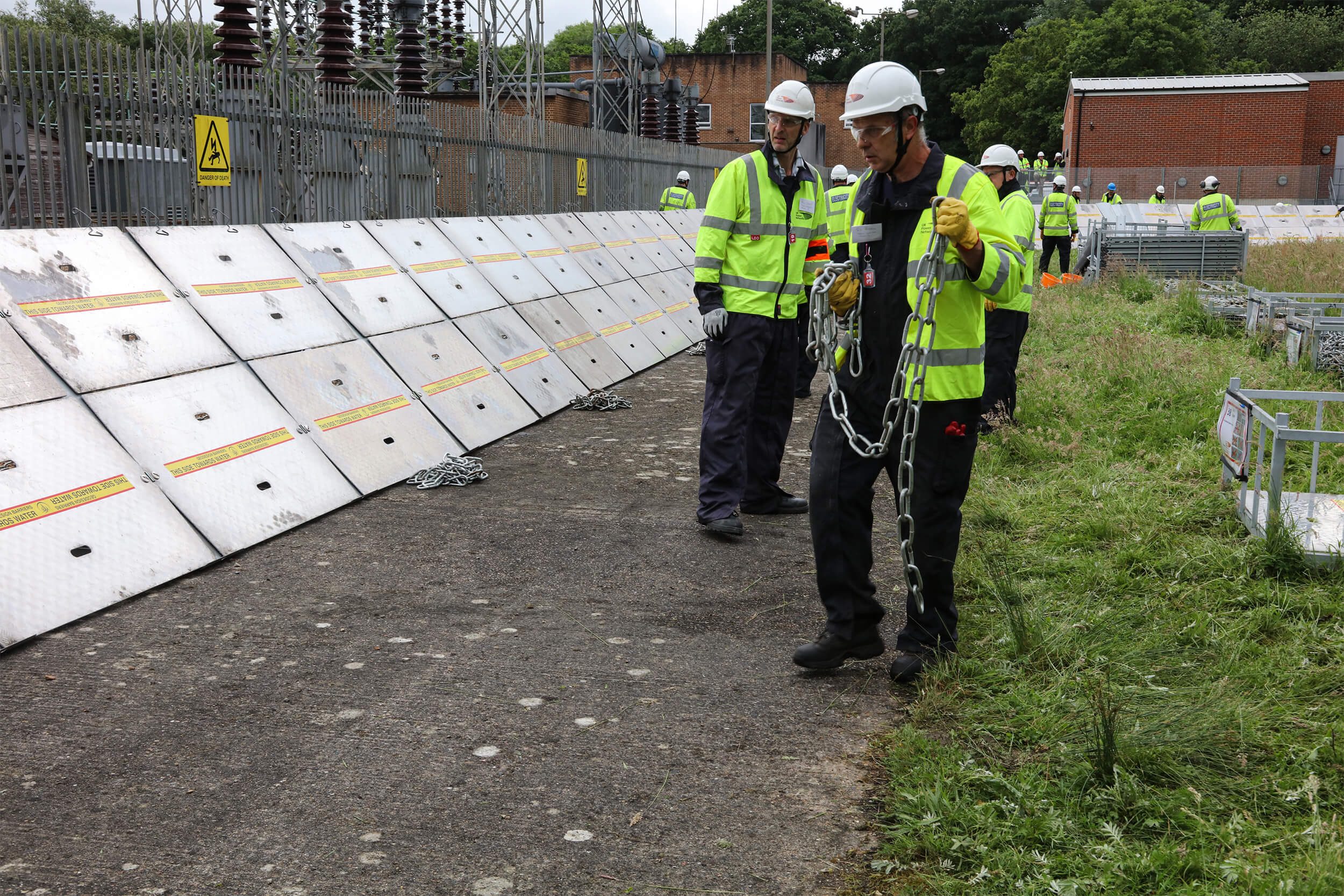
UK Power Networks substations
A distribution operator serving eight million customers holds barrier stock for its primary substations, matched to flood warnings and deployed by its own teams.
-
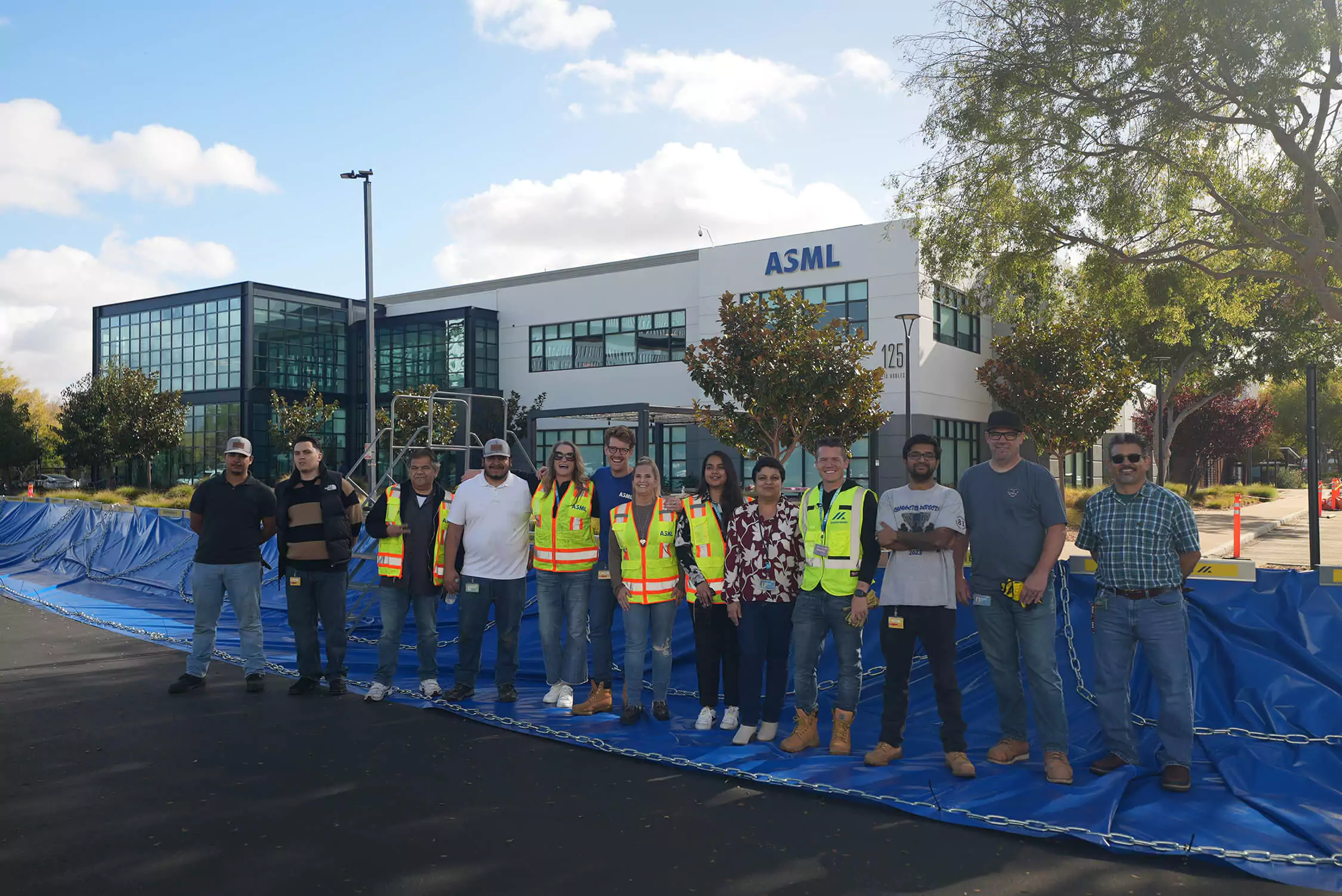
ASML, Silicon Valley
A semiconductor campus protected against a 500-year flood profile. The kind of site where the equipment inside is worth more than the building around it.
What your insurer and your board will ask
Two questions come up in every commercial conversation, and both have documentary answers.
Is it certified?
The Industrial and Heavy Duty series hold FM Approval to ANSI/FM 2510-2020, Approval Identification PR453294, granted by FM Approvals after third-party testing. The certificate is issued to Geodesign Barriers Inc., a company of Geodesign AB, and we provide the Certificate of Compliance on request.
A product certification is not a permit and not an endorsement of any particular deployment. Where an installation needs approval from an authority, obtaining it stays with whoever deploys.
How long does it last?
The structural components are steel and are reused across seasons. The membrane is the consumable and is replaced as it wears. Ask us for the warranty terms that apply to the series you are considering — they are written, and we will send them.
- PAS 1188 has been withdrawn and is no longer a live British standard. If a specification still calls for it, that is worth raising early.
- ISO 9001:2015 and ISO 14001:2015 cover the manufacturing.
- European and United States patents protect the system.
Commercial flood barriers: common questions
The questions facilities and risk teams ask before they get as far as a specification.
How long does it take to put up?
We quote 100 metres with a six-person crew. Elemental is up in 30 minutes, Industrial in 35 to 70 minutes, and Heavy Duty in 50 to 130 minutes, depending on the model. Actual time also depends on site access, the alignment of the line, and how often the crew has built it before — the second build is faster than the first.
Do we need a contractor, or can our own staff build it?
Your own staff. The system needs no tools, no machinery and no ground preparation, and a facilities team can be trained on it in an afternoon. That is the point of it: at two in the morning the people on site are the people who build it.
Will it damage our yard or car park?
No. The barrier is free-standing and anchors itself on the weight of the water pressing down on the membrane apron. Nothing is drilled, bolted or cast into your surfacing, and nothing has to be made good after the event. It works on asphalt, concrete and block paving.
What about the drains and pipes that run under the line?
They carry water to the dry side under pressure, and they are the most commonly missed part of a commercial deployment. Map every drain, duct and culvert that crosses the line, close them off before the build starts, and check each one physically before you sign the line off. One missed valve undoes an otherwise perfect build.
Where do we store it between floods?
Flat, on pallets or in stillages, on your own site. Storage volume depends on the series and the length of line — a site survey gives you the figure for your own perimeter so that storage is planned alongside everything else, rather than discovered afterwards.
How high can it protect?
From 0.41 metres in the Elemental series up to 2.45 metres in the Heavy Duty series. The right height comes from your expected flood depth and site conditions, not from picking the maximum — most commercial sites do not need the tallest series.
Keep going
All flood barriers
The full range, how the system works, and where it is used.
Compare barrier types
Deployable steel against sandbags, water-filled tubes, demountable gates and permanent walls.
Assess your flood risk
What your site is actually exposed to, before you specify anything.
Where systems reach their limit
Functional, structural and operational failure — and which one causes losses.
Write a response plan
The plan that decides who builds the line, and when.
Protecting a home instead?
The residential version of this page, same products at domestic scale.