Flood barriers for homes
A Geodesign flood barrier for home use is a line of panels that stands up across a doorway, a garage or a whole property perimeter — then comes apart and goes back into storage when the water drops. Nothing is bolted to your driveway. Nothing is thrown away after one flood.
-
0.41–2.45 mDam height across the three series (16–96 in)
-
0Tools, anchors or ground fixings required
-
ReusableDeployed season after season
-
30 yearsProtecting property through flood events worldwide
Two numbers decide everything
Before you compare products, you need two figures: how long a line you have to close, and how deep the water gets. Everything else — series, panel count, budget, how many people it takes to put up — follows from those two.
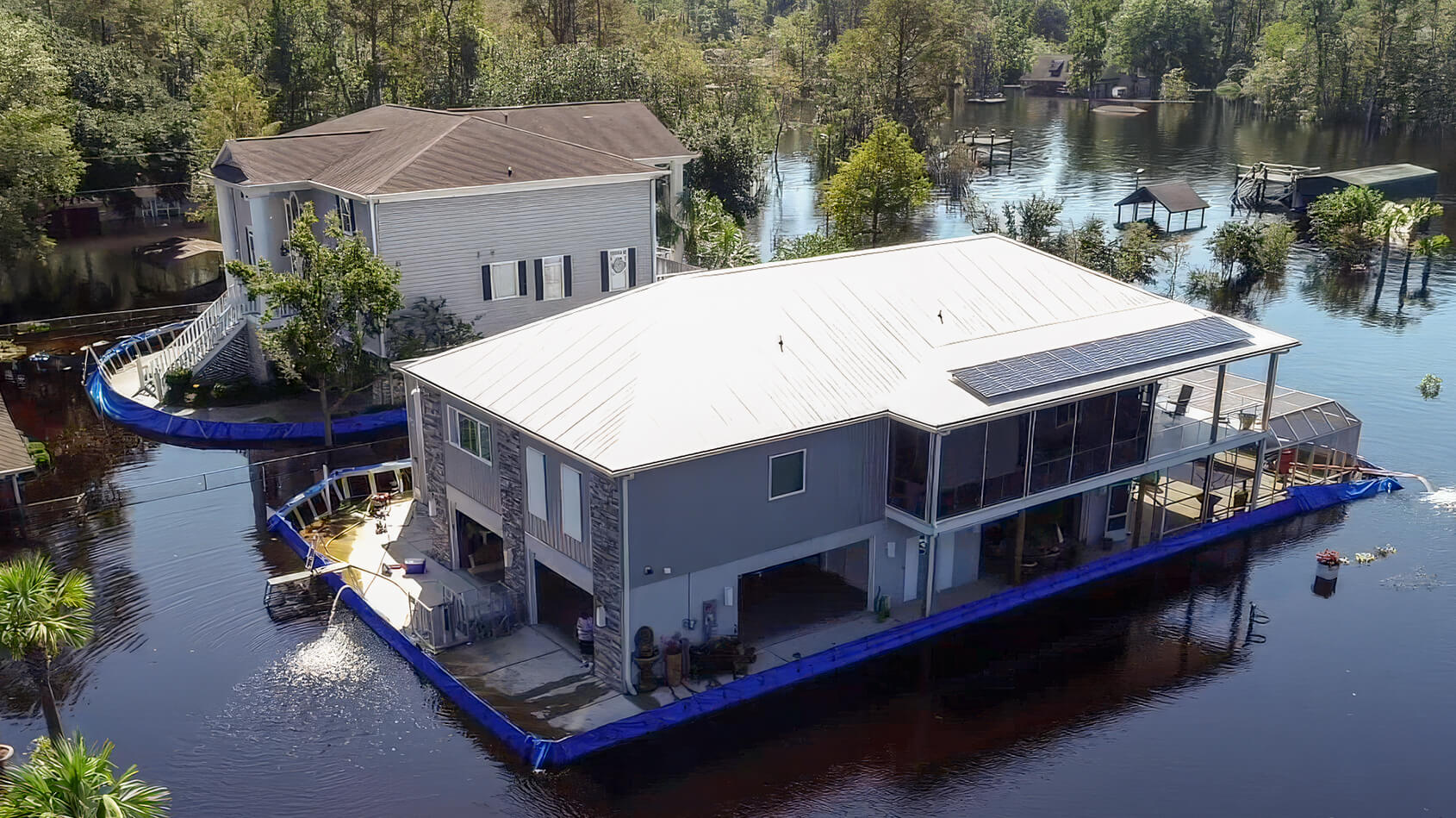
How long a line. Most homeowners are surprised here. A single front door is a short run. A double garage is several times that. Closing off a whole perimeter is a different order of magnitude again — and often the only approach that actually works, because water stopped at the front door simply walks round to the back.
How deep. This is the figure that decides the series. Water depth is not the same as the river gauge reading: what matters is the height above your own threshold. A property that floods to 200 mm (8 in) needs a fundamentally different system from one that floods to 1.2 m (4 ft).
- Single external door 1–2 m (3–7 ft) of barrier
- Double garage opening about 5–6 m (16–20 ft)
- Full property perimeter typically 30–60 m (100–200 ft)
- Storage, 50 m (165 ft) of Elemental about 1.3 m² (14 sq ft) of floor

Where the water actually gets in
Four openings account for most residential flood damage. Knowing which one is yours is worth more than any product comparison.
Doorways and thresholds
The obvious one, and the easiest to close. A short barrier run here is cheap insurance — but on its own it only helps if water cannot reach another opening.
Garage openings
The widest opening in most homes, and usually the lowest. A garage door is not a seal. A barrier line across the opening is what holds — and it needs to be as tall as the water, not as tall as the threshold.
Air vents, wells and low openings
Air vents and airbricks, dryer vents, basement light wells and service entries sit below the flood line and are easy to overlook. A perimeter barrier puts all of them behind the same line.
Ground saturation and seepage
No surface barrier stops water travelling under the ground. We say this plainly because it decides whether a barrier is the right answer for your property at all.
How seepage is managedWatch the barriers hold at a residential flood
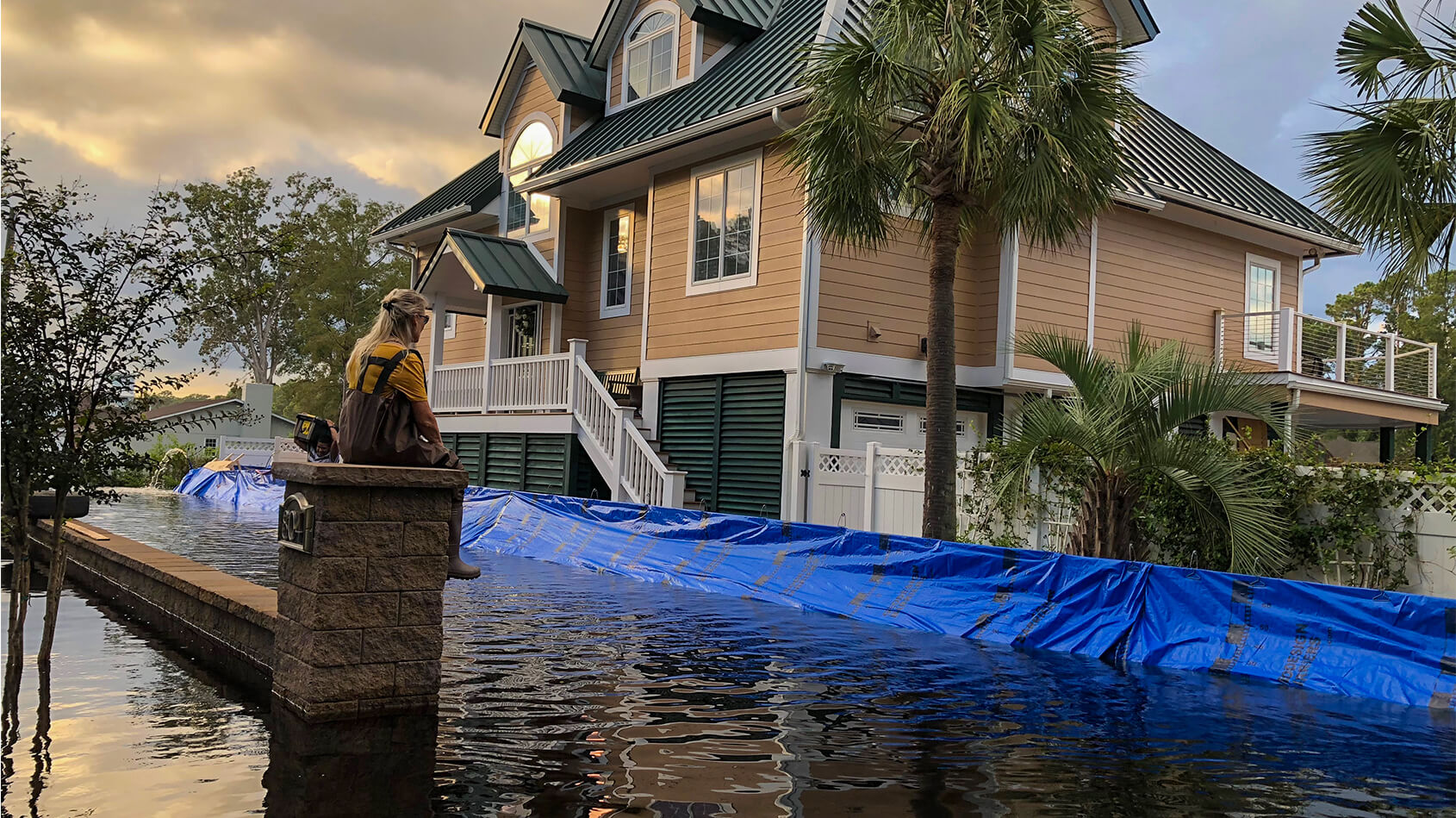
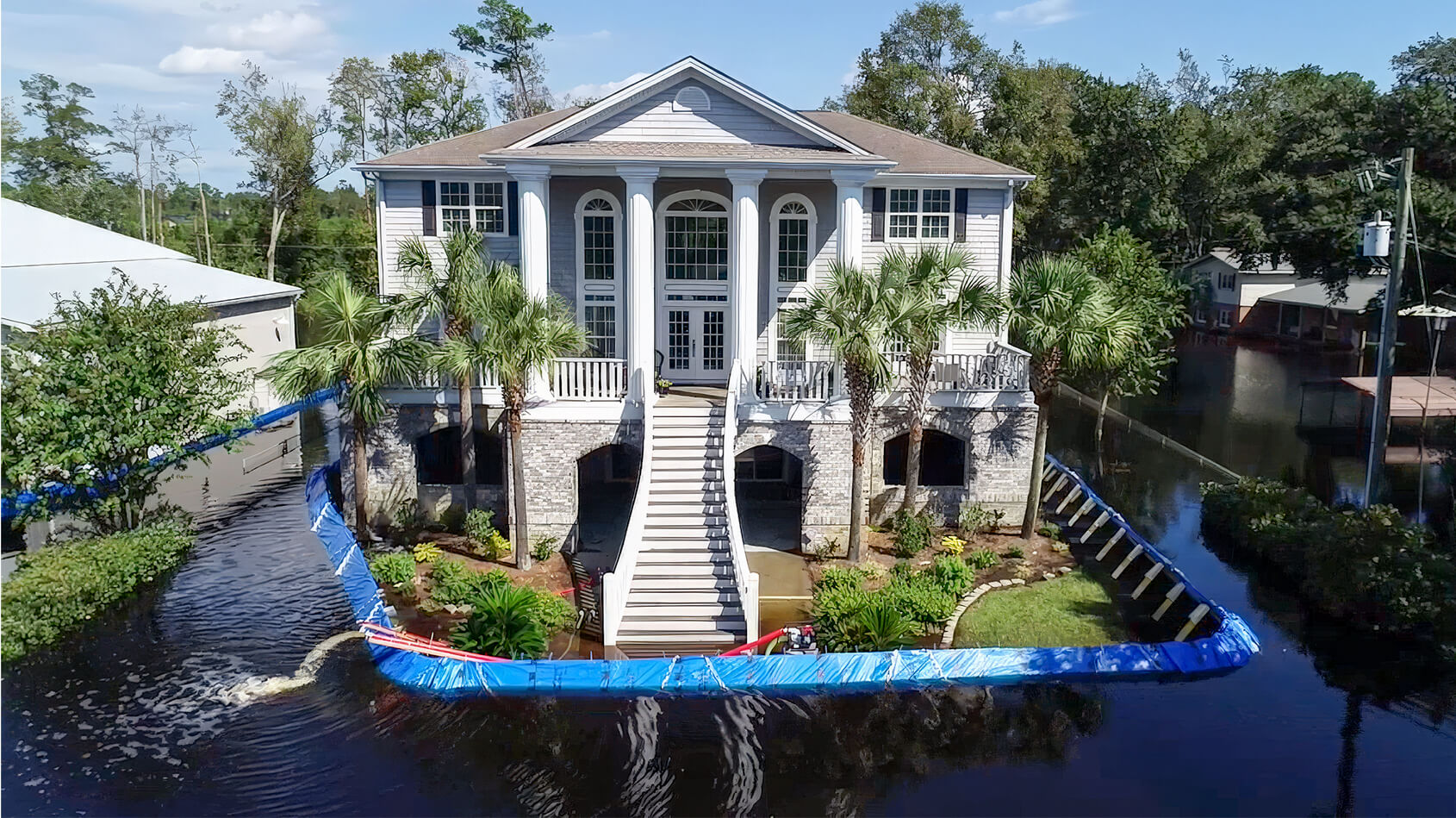
The clearest answer to “does this actually work on a house?” is not a specification sheet. It is footage of water standing against the line while the property behind it stays dry.
This film was shot in the United States, during Hurricane Florence in September 2018. We show it on every market page for one reason: it is the clearest footage we have of the barrier standing against water at ordinary houses. We would rather label where it was filmed than pretend it was filmed near you.
The flood profile is the part that transfers, and it transfers almost everywhere. Florence was not primarily a wind event but a water one — days of rain and record river levels, with properties under water well after the storm passed. That is the same profile as a monsoon river flood, a spring snowmelt flood or a European winter flood: enough warning to deploy, then sustained standing water rather than a brief surge. It is what these barriers are built for.
It is also the honest test of everything above. The two numbers, the four steps and the no-fixings principle either hold when the water arrives, or they do not.
- EventHurricane Florence, Sept 2018
- WhereCarolina coast, USA
- Other deploymentsIronbridge, UK · Maryborough, AU · Myrtle Beach, USA
- ProtectedResidential property
Which barrier suits which property
Twelve models across three series. For most houses the answer is Elemental. Larger residential sites — apartment blocks, shared parking areas, managed housing — usually need Industrial or Heavy Duty.
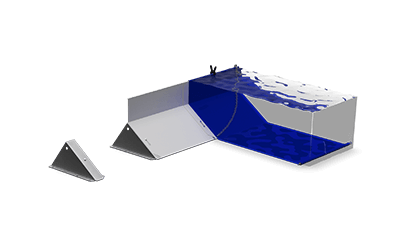
Elemental
The residential system. Light enough to be carried and placed by hand, with no tools and nothing fixed to the ground. Three models, E41, E51 and E61. This is the series most houses will use.
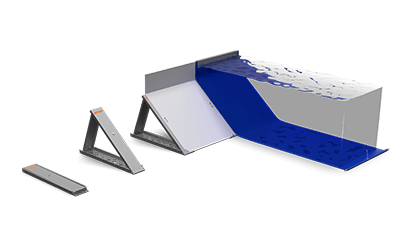
Industrial
For deeper water and longer runs — apartment blocks, shared parking areas and common areas. Four models, P61 through P121. FM Approved to ANSI/FM 2510-2020 — ask for the certificate covering your model.
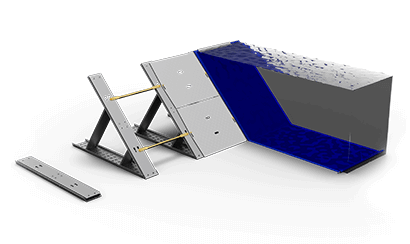
Heavy Duty
Street and community scale. Where a whole road or district is protected as one line, usually by a municipality or a flood risk authority rather than an individual owner. Five models, C122 through C245. FM Approved to ANSI/FM 2510-2020 — ask for the certificate covering your model.
| Series | Dam height | Models | Typical residential use |
|---|---|---|---|
| Elemental | 0.41–0.61 m (16–24 in) | E41, E51, E61 | Houses: doorways, garages, full perimeter |
| Industrial | 0.61–1.21 m (24–48 in) | P61, P81, P101, P121 | Apartment blocks, shared parking areas and common areas |
| Heavy Duty | 1.22–2.45 m (48–96 in) | C122, C152, C184, C213, C245 | Street, district and community-scale protection lines |
Four steps, no tools
The system goes up by hand. There is no drilling, no anchoring and no concrete — which is what makes it removable, and what makes it usable by a homeowner rather than a contractor.
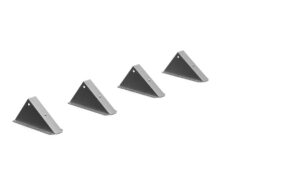
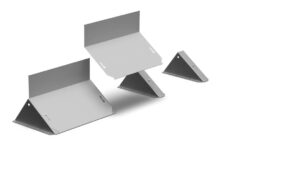
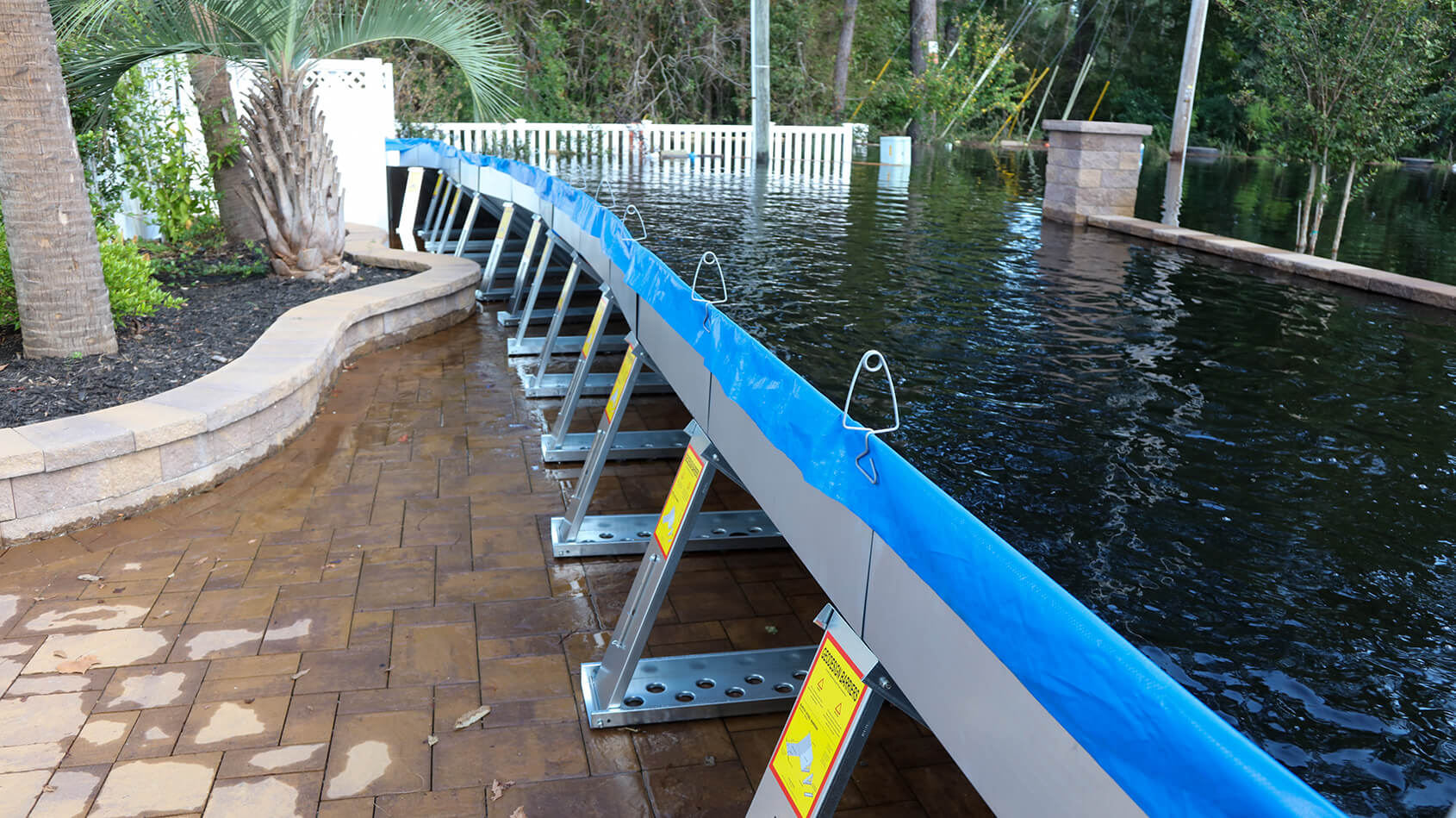
Position the Metal Supports
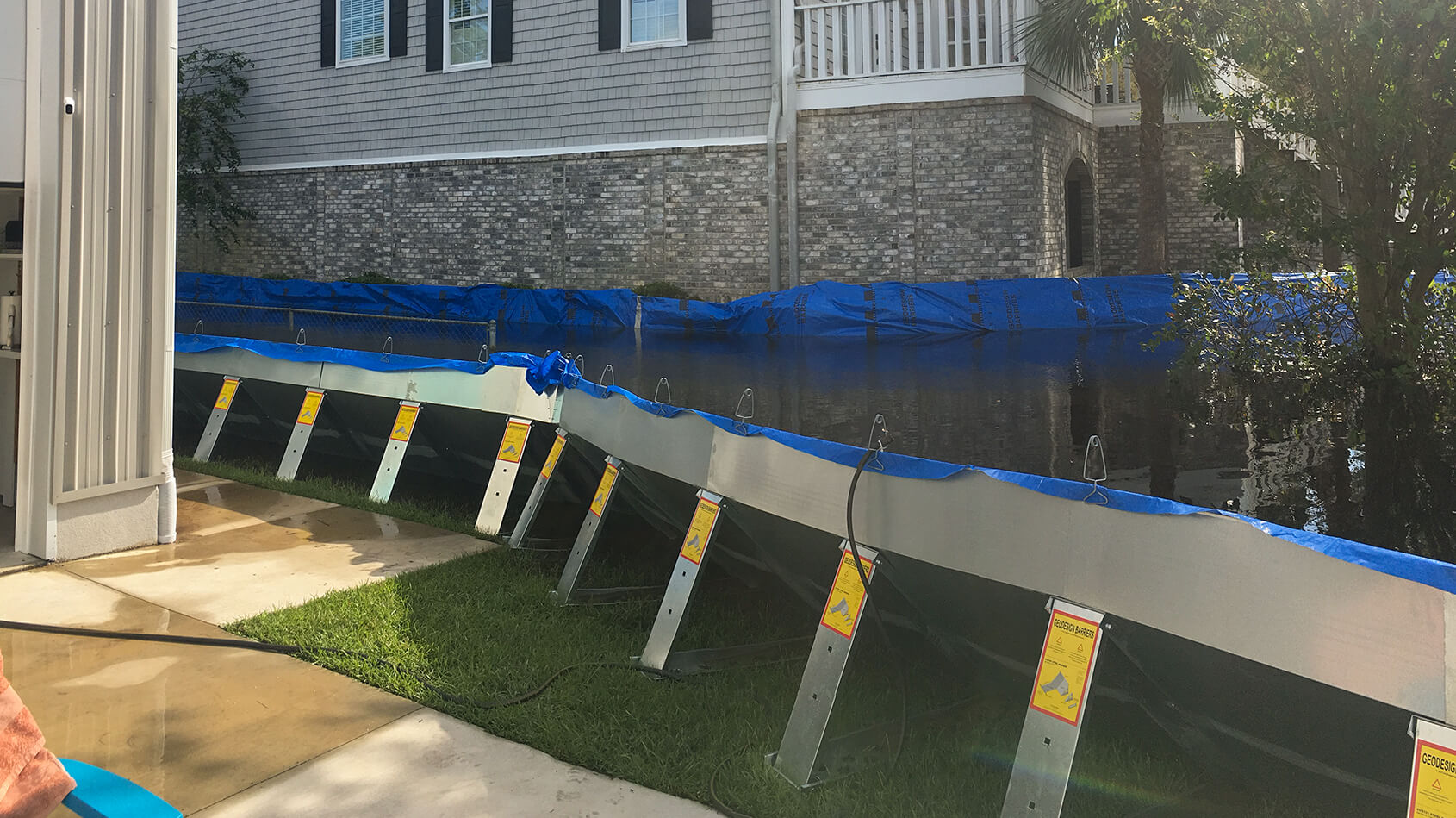
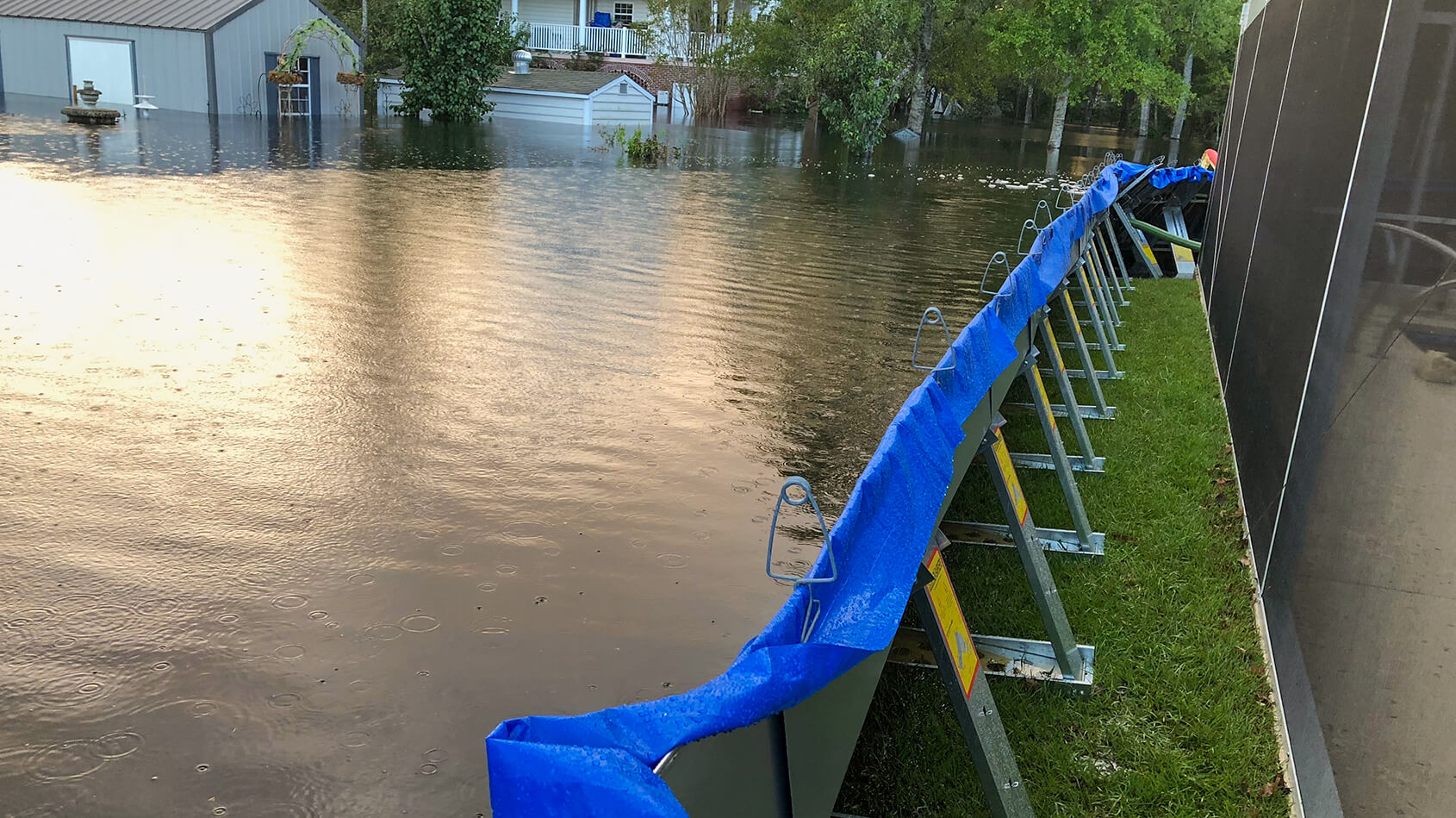
Angled steel supports are set out by hand along the line you measured. They rest on the ground — nothing is drilled, bolted or cast into your driveway or lawn.
Mount Steel Panels
Steel panels drop into the supports and lock the run together. Panel by panel the line closes, whether it is a single doorway or a full perimeter.
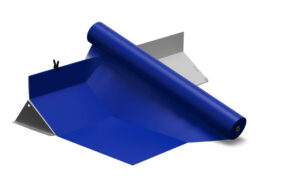
Layer with Poly Membrane
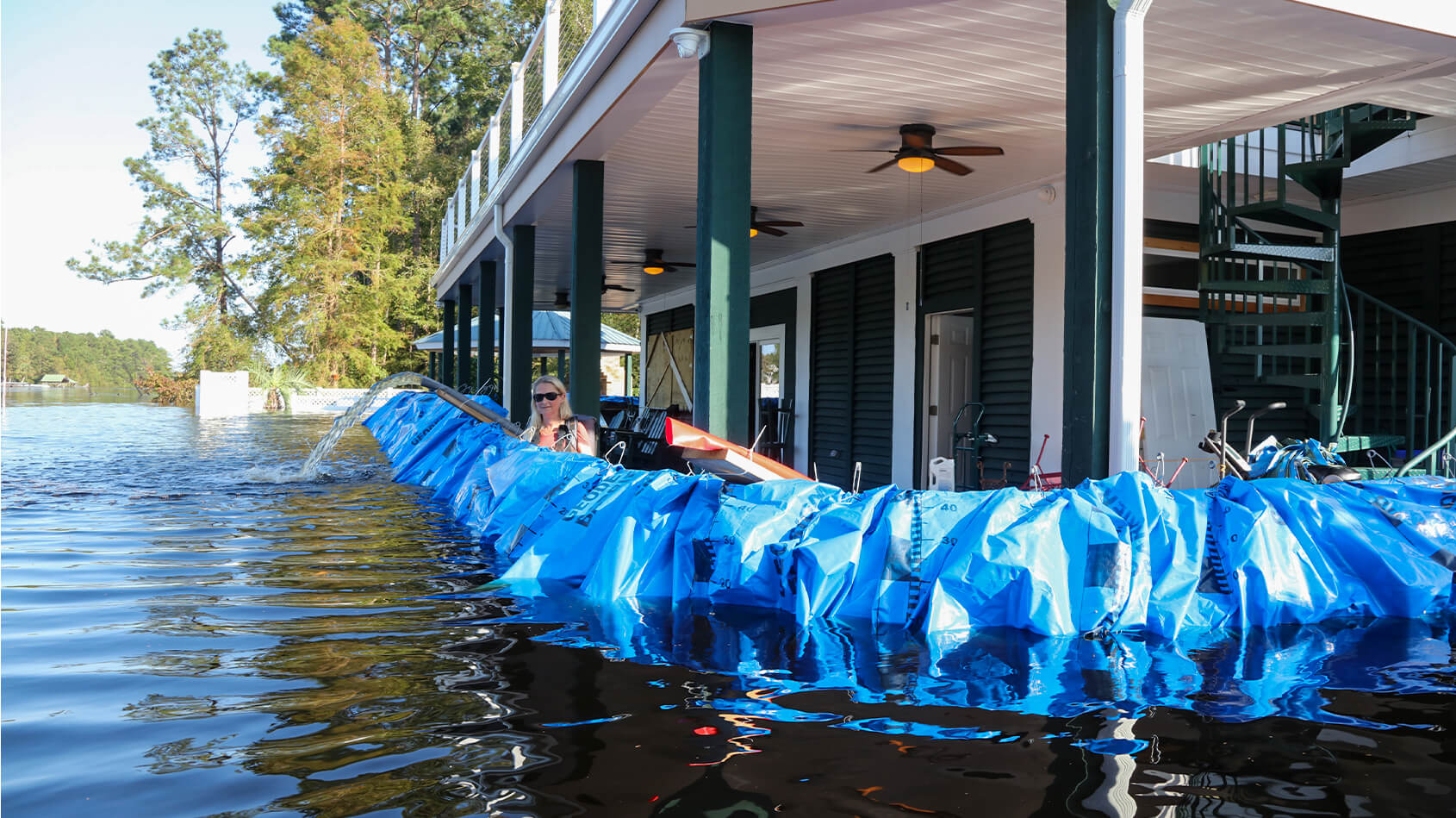
A polymer membrane is laid over the panels and out along the ground on the water side. This is the seal — the panels carry the load, the membrane keeps the water out.
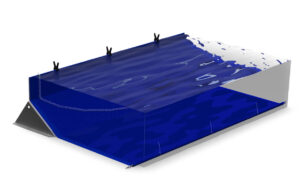
Self-Anchoring Through Water
The rising water presses down on the membrane and holds the whole line in place. The flood anchors the barrier — which is why no ground fixing is needed, and why it all comes apart afterwards.
Taking it down runs the same sequence in reverse. Around 50 m (165 ft) of Elemental stores in about 1.3 m² (14 sq ft) of garage floor, ready for the next season.
Against sandbags
Sandbags are the real alternative most homeowners are weighing, not another manufacturer's barrier. So here is the comparison in full, including where sandbags still win.
Sandbags
- Filled and placed one at a time; labour scales with length
- Absorb contaminated flood water; usually disposed of afterwards
- Bulky and heavy to store, and degrade between seasons
- Height is limited by how high a bag wall can be stacked stably
- Widely available at short notice, at low cost per unit
Geodesign barriers
- Panels and supports go up as a line; labour scales far more slowly
- Cleaned and reused season after season
- Around 50 m (165 ft) stores in about 1.3 m² (14 sq ft) of floor space
- Rated dam heights from 0.41 m (16 in) up to 2.45 m (96 in) across the series
- Higher up-front cost; the case is made over repeat floods
Where sandbags still make sense. For a single doorway, an awkward gap around a step, or a one-off event on a property that has never flooded before and probably will not again, a handful of sandbags is a reasonable answer and we will say so. The case for a barrier system is repetition, length and depth — a property that floods more than once, a line longer than a doorway, or water deeper than a bag wall will hold.
Flood barriers for apartment blocks and managed residential property
Protecting twelve apartments, a shared parking deck or a whole residential district is a different problem from protecting one house — different economics, different decision-making, and a different conversation with an insurer. It is also where consumer flood insurance schemes tend to stop: in most countries they are written for single dwellings, not for multi-unit buildings.
The cost per protected unit falls sharply. One barrier line across a shared entrance or parking deck protects every unit behind it. Split across a shared building fund or a portfolio, flood barriers reach a cost per door that no individual owner could justify alone.
It is an asset, not a consumable. A barrier system sits on the books and is deployed for as many seasons as it lasts. Sandbags are bought, used once and disposed of as contaminated waste every single time — and in a growing number of places the local authority no longer supplies them to households at all.
Deployment has to be planned, not improvised. At community scale the barrier is only half the answer — the other half is who puts it up, when the decision to deploy gets made, and how much warning time you have.
-
Apartment blocks and owners’ associations
Shared entrances, parking areas and common areas closed with one line, funded from the reserve fund rather than by individual owners.
-
Property managers and portfolios
One barrier stock redeployed across multiple addresses as the forecast dictates, instead of single-use material sitting at every site.
-
Housing providers and municipalities
District and community-scale lines using the Heavy Duty series, deployed by a trained crew as part of a flood emergency response plan.
See the FERP guide
Certification, and what your insurer will ask for
For an insurer, a lender or a property manager, the question is not whether a barrier looks strong. It is whether independent evidence sits behind it — and which system that evidence actually covers.
FM Approved — Industrial and Heavy Duty
The Industrial and Heavy Duty series are certified by FM Approvals to ANSI/FM 2510-2020, the standard for flood abatement equipment. Ask us for the certificate covering the model and dam height you are specifying — the scope differs by model, and a general claim would not tell you what you need.
It carries more weight than a typical product mark: FM Approvals is the certification arm of FM Global, one of the world’s largest commercial property insurers. The mark is issued by the insurance industry, not by us.
Nine models carry the approval — the four Industrial and the five Heavy Duty barriers, under Approval Identification PR453294. We would rather set the scope out here than have you find it out during a claim.
Which standard applies where you are
National flood product standards differ from one country to the next, and several of the ones people are told to look for cover a different class of product altogether — barriers fitted into a single opening rather than free-standing lines of this type. Some have been withdrawn and replaced while suppliers still advertise them.
The question worth asking any supplier, anywhere, is the same one: which standard do you hold a current certificate to, for which product, and to what dam height. Ask us the same question and we will send the certificate rather than a claim. If a local standard applies in your country, tell us which and we will say plainly whether we hold it.
Geodesign holds ISO 9001 and ISO 14001, and the systems are covered by European and US patents (US 10,508,396 B2 and EP 3 359 743 B1).
Three questions to ask your insurer
What we will not tell you is that a barrier will lower your premium. That is your insurer’s decision, and it varies by country, by insurer and by how your policy is written. What you can do is settle it before you buy rather than after.
Ask three questions. Does documented flood mitigation affect the premium? Does it affect whether you can get flood cover at all — in a high-risk area that is usually the bigger question of the two. And what evidence do they want on file: a specification, a photograph of the deployed line, a certificate, a deployment plan.
Ask one more while you are there: does the policy pay to reinstate the property as it was, or to replace what was lost. That answer is what decides whether the barrier has to hold the water out or merely slow it down.
On grants and relief schemes. Many countries operate a flood resilience grant, a post-event repair scheme or a tax relief that can be applied to permanent or demountable flood protection. They are national, they change often, and they are usually switched on only after a declared event. We do not track them, and we will not tell you one is available. Your local authority or national flood agency is the place to ask — it is worth doing before you buy, not after.
The three ways water reaches a house
Geodesign has protected sites through three decades of flood events, and the barriers have been deployed at homes, streets and riverside towns in Europe, North America and Australia. Wherever you are, flood water arrives in one of three ways — and each gives you a different amount of time to act.
Surface water. Rain falling faster than the drains can take it. In several countries, England among them, this puts more properties at risk than rivers and the sea combined, and it is the one that gives almost no warning — minutes to hours, not days. It is also the reason a system that needs a contractor and a day of installation protects nothing.
River flooding. Water builds in a catchment over hours or days and arrives downstream on a schedule you can watch. Wherever a national or regional flood warning service exists, this is the flood type it is best at forecasting, and it usually gives enough notice to put a line up calmly.
Coastal and tidal flooding. Storm surge riding on a high tide. The tide table is published years in advance, so the timing half of the problem is known before the storm exists.
The deployment window is what decides whether any barrier is useful. The four-step, no-tools sequence above exists for that reason: it is what lets a household put its own line up inside the warning time it actually has, rather than the warning time a product brochure assumes.
Two things are worth checking before you buy anything, and both are free. First, which flood type your property is exposed to — most national flood agencies and many regional water authorities publish a flood map. Second, whether you are inside a warning service, and how much notice it gives. Those two answers, together with your two numbers, decide the system.
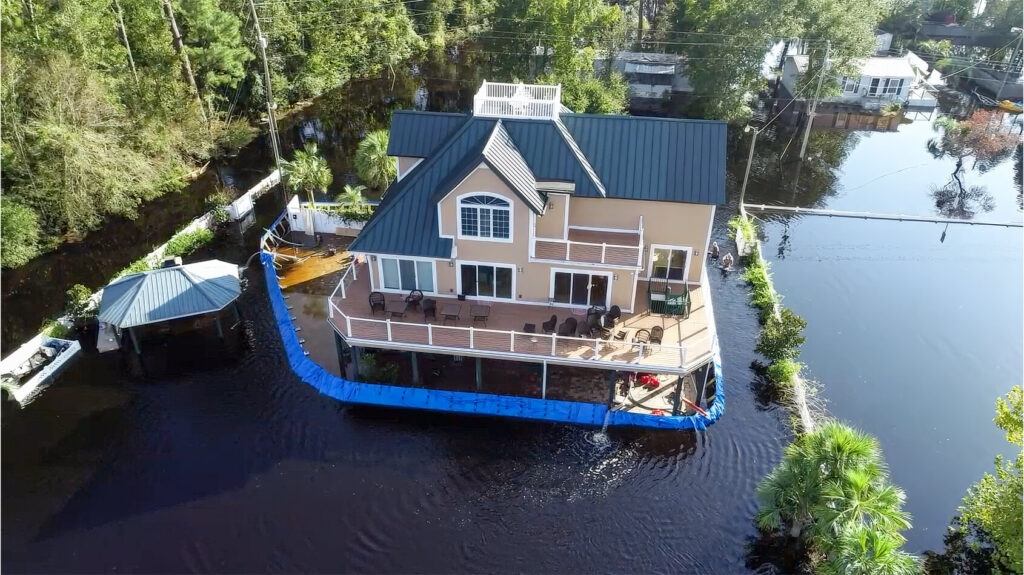
Barriers protecting homes
Deployments at residential properties.

Flood barrier for home use: common questions
The questions people actually search for before buying.
How do you stop flood water from entering a house?
You close every opening below the flood line with a continuous barrier — not just the front door. Water that is stopped at one opening will find the next one: a garage, a basement window well, a vent, a utility penetration. That is why a perimeter line usually works where a single doorway barrier does not.
A demountable barrier does this by standing a sealed line around the property, held down by the weight of the water itself rather than by anchors. What no surface barrier can stop is water travelling underground through saturated soil, which is a separate problem.
How do you keep flood water out of a house without sandbags?
With a demountable barrier system: panels set into angled support legs, with a membrane skirt running out along the ground on the water side. The rising water presses the skirt down and seals the line, so nothing has to be fixed into your driveway or lawn.
Unlike sandbags it is not filled by hand, does not absorb contaminated water, and is not disposed of afterwards — the same panels are cleaned and used again the following season.
What are the best flood barriers for homes?
There is no single best system — the right one depends on your two numbers. For water up to roughly 0.6 m (2 ft) over a short to medium run, a lightweight demountable steel system such as the Elemental series is normally the right class of product. For deeper water or a multi-unit building, a heavier system is needed.
The questions worth asking any supplier: what is the rated dam height, how long does deployment take and with how many people, is there independent certification behind the rating, and how much storage space does it need between floods.
What is the difference between permanent and temporary flood barriers for homes?
A permanent flood barrier — a concrete flood wall, a raised threshold, a fixed flood gate — is built into the property and is always there. It needs no deployment decision, but it costs more up front, requires construction and permits, changes how the property looks, and cannot be moved or adapted.
A temporary or demountable barrier is stored between events and put up when a flood is forecast. It is far less expensive, needs no construction, and can be reconfigured or moved — but it depends on someone deciding to deploy it, and on there being enough warning time to do so.
Geodesign makes demountable systems, not permanent flood walls. If your property floods with no warning at all, a permanent solution may genuinely suit you better, and we would rather say so.
Do flood barriers work around a whole property, or only at doorways?
Both, and the whole-property line is more often the one that works. The system is modular: the same panels and supports form a run of a metre or two across one doorway or a continuous line of thirty to sixty metres around a house and garden.
A doorway-only barrier protects you only if water genuinely cannot reach any other opening at that depth. On most properties it can — which is why a full perimeter, typically 30 to 60 m (100 to 200 ft) for a single-family home, is the usual recommendation.
What are the benefits of a year-round defensive barrier for homes?
A barrier system you own and store on site is available on every forecast, not just the one you managed to prepare for. There is no scramble for supply when a warning is issued and every hardware store in the county has sold out.
Because the panels are reusable, the cost is spread across every season they serve rather than repeated at each flood. And because the system is demountable, it is not visible on the property for the eleven months of the year when there is no flood.
How much does a flood barrier for a home cost?
There is no list price, because there is no standard length. A quotation is built from four things: how long a line you need to close, how deep the water gets — which decides the series and therefore the price per metre — the ground you are closing across, and how far the system has to be shipped to reach you.
Two of those you can supply in one message. The other two we work out with you. What that means in practice is that a single doorway and a full property perimeter are not the same order of cost, and neither is Elemental against Heavy Duty — so a figure quoted without your two numbers would be a guess, not a price.
Send us the length and the depth and you get a specific answer: which series, how many panels, and whether a barrier is the right answer for your property at all. Duties, local taxes and delivery vary by country and are shown separately, never buried in the panel price.
Keep going
All flood barriers
The full range across every series and application.
Compare the systems
Elemental, Industrial and Heavy Duty side by side.
Assess your flood risk
Work out your exposure before you choose a system.
Flood protection guide
How the pieces fit together — risk, monitoring, response.
Commercial and industrial sites
The Industrial series, for business premises rather than homes.
Deployments and news
Where Geodesign barriers have been used, and how they performed.