Flood walls you put up when the water comes
Most flood walls are permanent: concrete or sheet piling, built once and left standing. Ours are not. Geodesign flood walls are stored flat, raised by hand in hours and taken down afterwards, leaving nothing in the ground. No sand, no aggregate, no water to pump, nothing drilled. They hold up to 2.45 m (8 ft) of water, and they are used in 24 countries by utilities, industry, water authorities and city governments.
 FM Approved · ANSI/FM 2510-2020 certified
Flood barriers built for every site
Three barrier series covering 0.41 to 2.45 metres of dam height, plus modular cofferdams. All three series are compatible, so one line can step up and down to follow the ground.
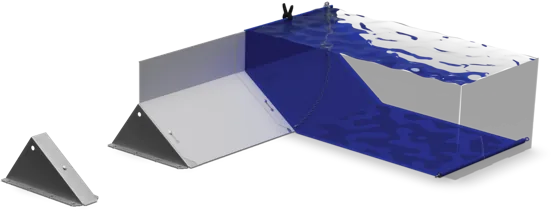
Elemental
0.41–0.61 m (1 ft 4 in–2 ft). The lightest series, for doorways, small perimeters and fast deployment by one or two people.
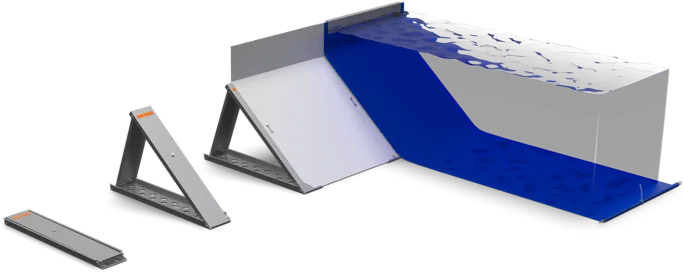
Industrial
0.61–1.21 m (2–4 ft). Mid-height walls for commercial premises, industrial sites and municipal assets. FM Approved to ANSI/FM 2510-2020.
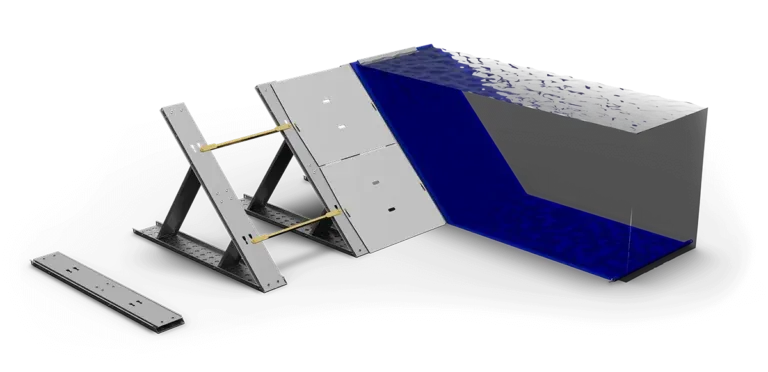
Heavy Duty
1.22–2.45 m (4–8 ft) across five models, C122 to C245. Deep water, waves, debris and overtopping. FM Approved to ANSI/FM 2510-2020.
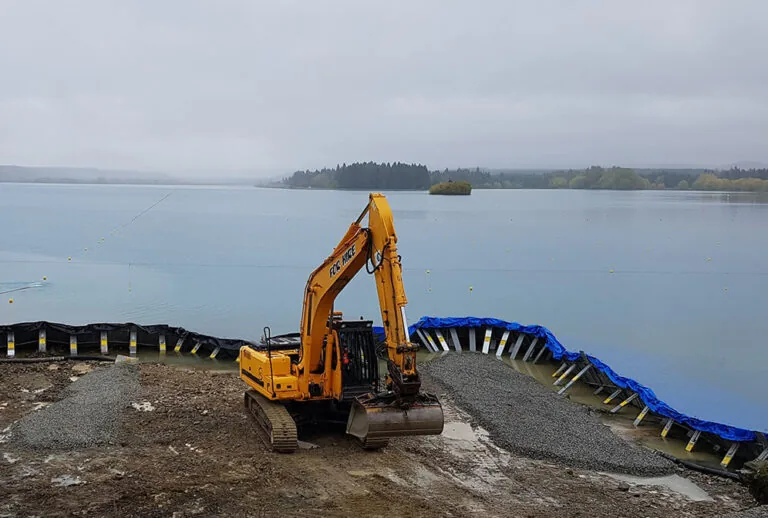
Cofferdams
The same modular system used to create a dry working area for temporary works in and beside water.
Built for real deployments, not spec sheets
The shift is often not about one barrier looking stronger on paper. It is about reducing fill logistics, simplifying deployment, improving repeatability, and matching real operational constraints.

No fill logistics
No sand, aggregate, or on-site water filling is required — reducing mobilization demands, clean-up, and dependence on external fill material.

Repeatable manual deployment
Designed for repeatable manual setup using modular structural components, with no specialized tools required under normal deployment conditions.

Perimeter-ready by design
Well suited to longer defensive lines, controlled geometry, and repeatable perimeter protection — not just isolated openings.

Built for real site conditions
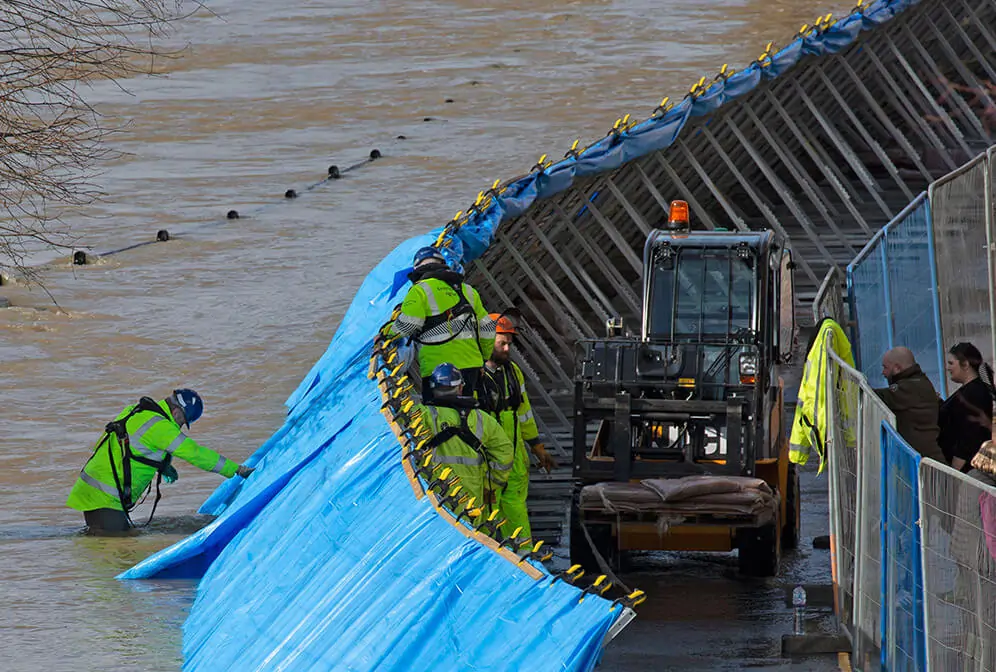
Configurable for corners, changes in direction, and irregularities such as kerbs, lampposts, bollards, fences and uneven ground — the things that are actually in the way on a real street, quay or plant perimeter.
FM Approved to ANSI/FM 2510-2020 — independent third-party verification of structural performance, durability, and manufacturing quality control.
How Geodesign flood barriers are deployed
A repeatable five-step sequence a trained crew runs by hand — no fill, no heavy plant. A six-person crew puts up 100 m of Heavy Duty C122 in about 50 minutes.
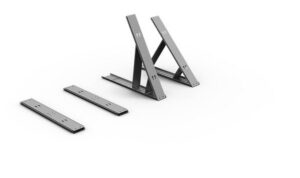
Place and Lock Supports
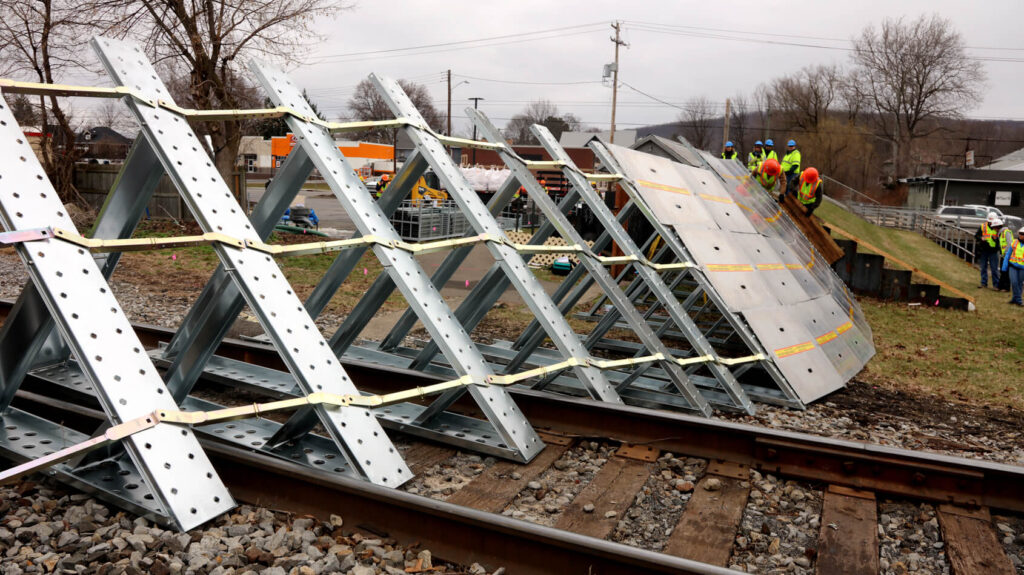
Place A-frame supports along the intended barrier line and lock them into position.
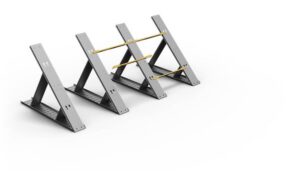
Connect with Link Bars
Slide the link bars into the supports to establish alignment and structural continuity.
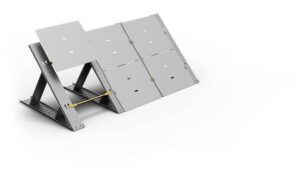
Mount Panels
Install the panels onto the link bars to form the structural barrier face.
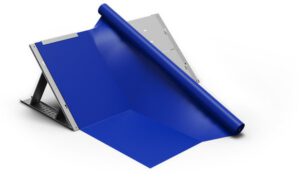
Roll Out the Membrane
Position the liner over the barrier face and add chain ballast as needed.
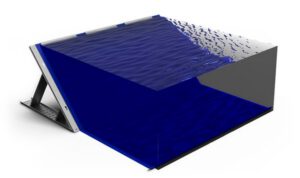
Self-Anchor Under Flood Loading
As water rises onto the liner, the system stabilises through geometry, self-weight and hydraulic loading.
Deployed in 24 countries
Three we can take you through in detail. They are not the whole list — ask us for references near your site.
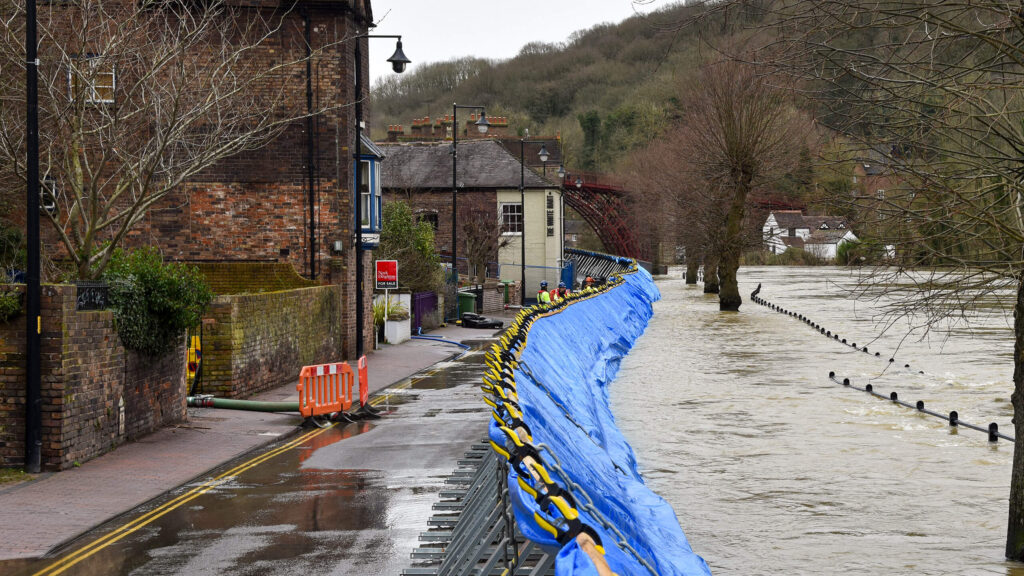
Ironbridge, on the River Severn
The Environment Agency has used Heavy Duty C122 and C184 barriers at Ironbridge across repeated flood seasons, protecting riverside property along the constrained historic Wharfage when the Severn runs high.
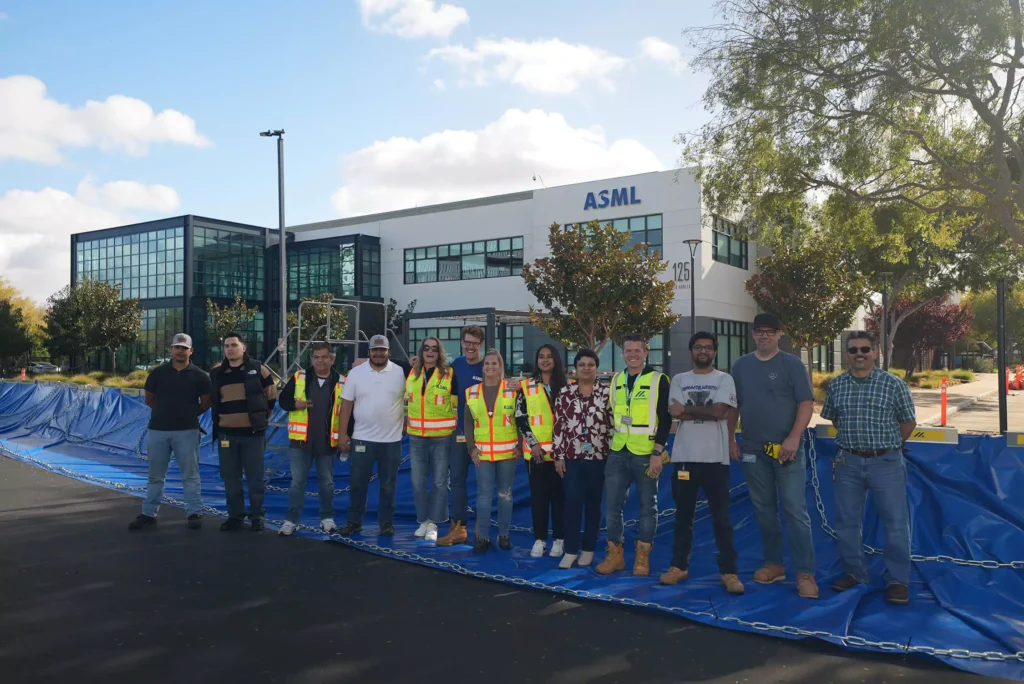
ASML, Silicon Valley
ASML protected its San Jose R&D campus, close to the flood-prone Guadalupe River, with Industrial P101 barriers — chosen because FM Approval is what insurers increasingly ask for. The site team trained over two days with a Geodesign field engineer before the first flood season.
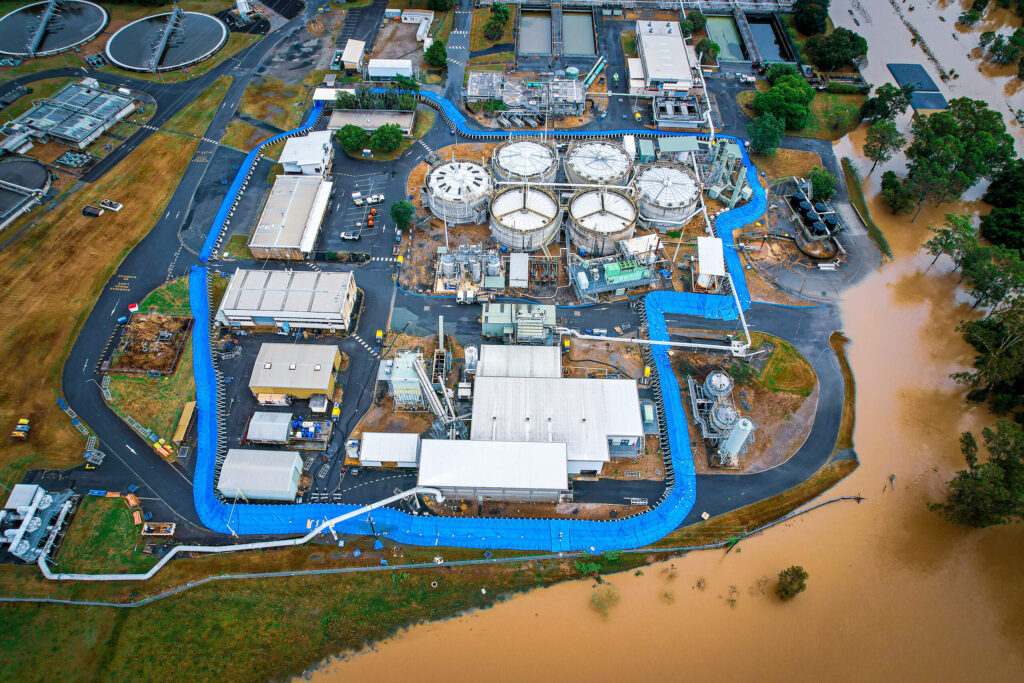
Oxley Creek treatment plant, Brisbane
After the 2022 floods put the plant under water, Urban Utilities installed 600 metres (2,000 ft) of Heavy Duty barrier around it — the largest Geodesign deployment in the southern hemisphere. Raised ahead of ex-Tropical Cyclone Alfred in March 2025, it was never overtopped and the plant stayed in service.
How the barriers go up, and what they hold
Trusted where failure isn't an option
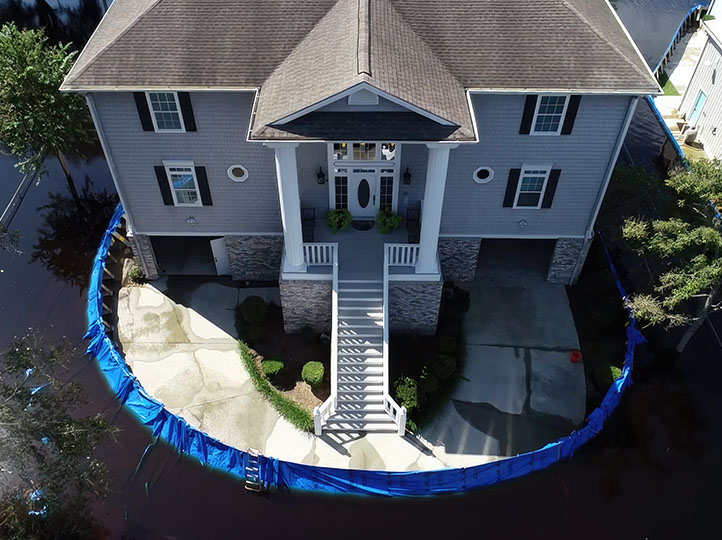
Property & facility owners
Commercial, industrial and institutional buildings on land at risk of flooding.
Utilities & power
Substations, pumping stations and plant that has to stay on through a flood.
Critical national infrastructure
Data centres, hospitals, transport and water — where downtime is not an option.
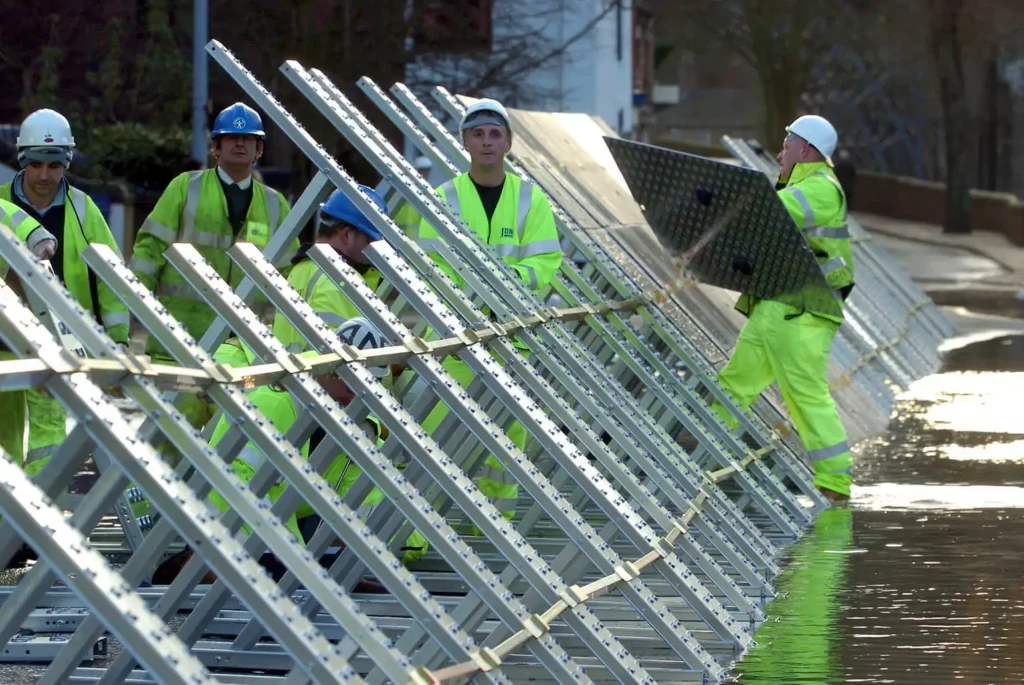
Governments & water authorities
Cities, municipalities, water boards and national flood agencies protecting communities and public assets.
Trusted by leading companies and authorities
Among them ExxonMobil, Duke Energy, RATP, ASML, Waterschap Limburg, Urban Utilities and the Environment Agency, alongside national grid operators, water authorities and city governments across 24 countries.

















What customers and authorities have said
There are many places where you can't build permanent defences. In that case, temporary barriers like this can make a real difference — and the thing about these new ones that we've acquired is that they're lighter and quicker to assemble, so it will enable us to be even faster next time we need to respond.
The Geodesign flood barrier system is incredibly robust, yet surprisingly simple to install. Seeing how seamlessly the pieces came together gave us real confidence that, with the right preparation and teamwork, we can protect the site and be ready for even the worst flood event.
The feedback from this enthusiastic group was unambiguous: we made the right choice with Geodesign Barriers. It is suitable for use everywhere and therefore also in difficult circumstances, because the flexibility is higher than other systems.
Amazingly simple product that was easy to assemble and bring down and saved our CBD (Central Business District) from flooding.
The Geodesign Barriers were a game-changer for us. Their rapid deployment around the substation was a critical factor in keeping the lights on for countless communities.
It's an essential exercise to ensure that our teams are well-prepared and to check the integrity of the barriers.
Latest articles & case studies
 History
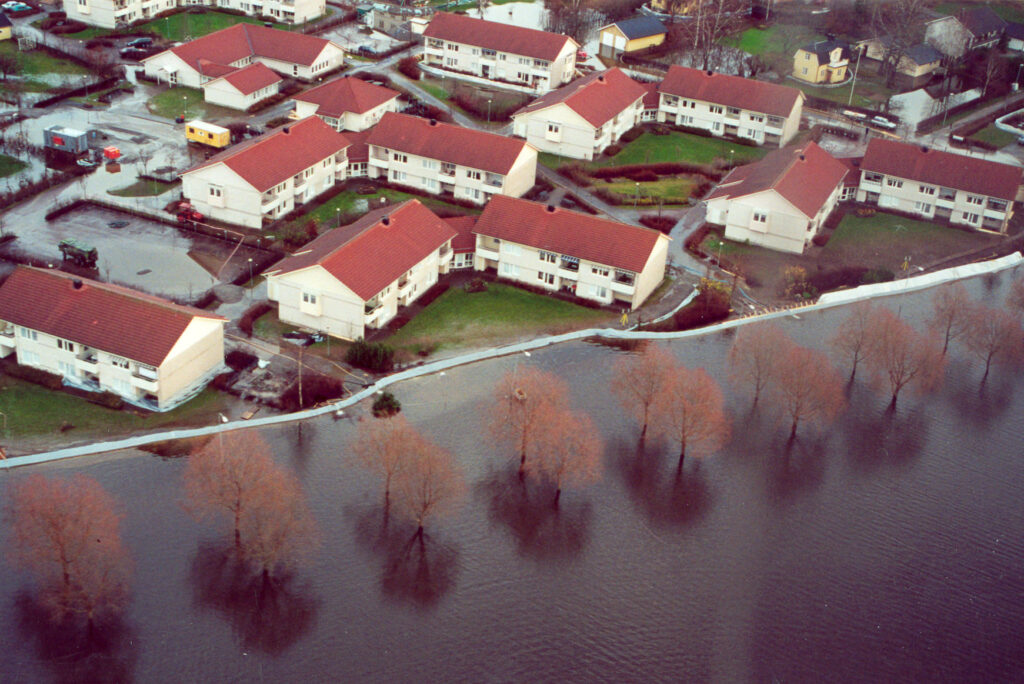
Arvika 2000: where mobile flood protection was proved
Nearly two kilometres of barrier around a Swedish town whose lake rose 3.14 m above normal. The districts behind the line stayed dry; the ones without it did not.
Read more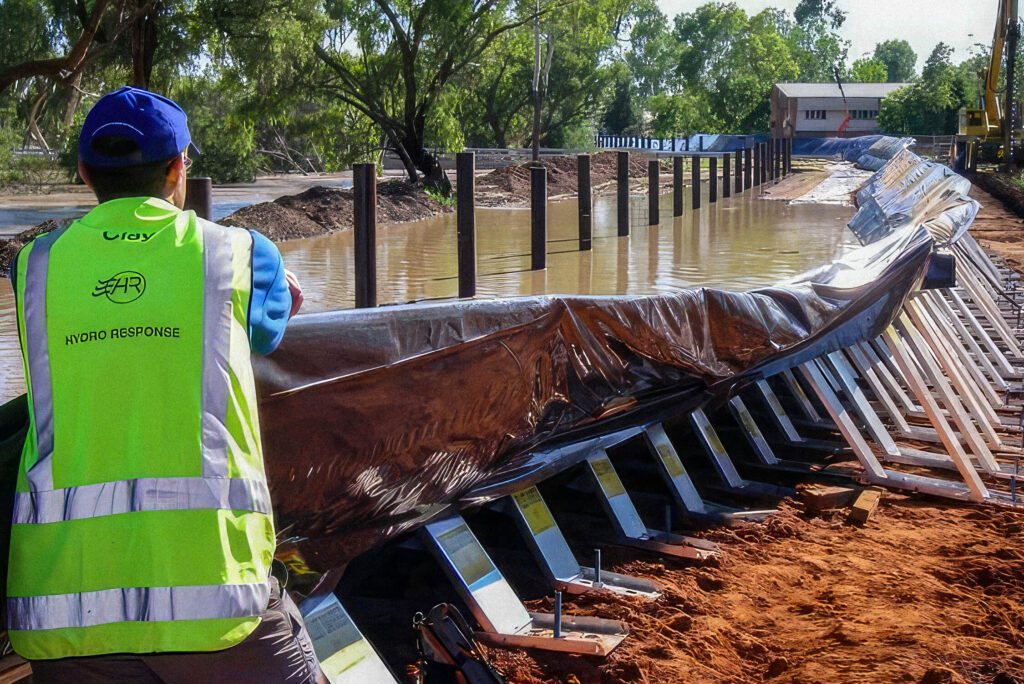 Case study
The town that calls it “the levee”
Charleville, Queensland, built its defence overnight with local volunteers as the Warrego River rose — and the barrier held.
Read more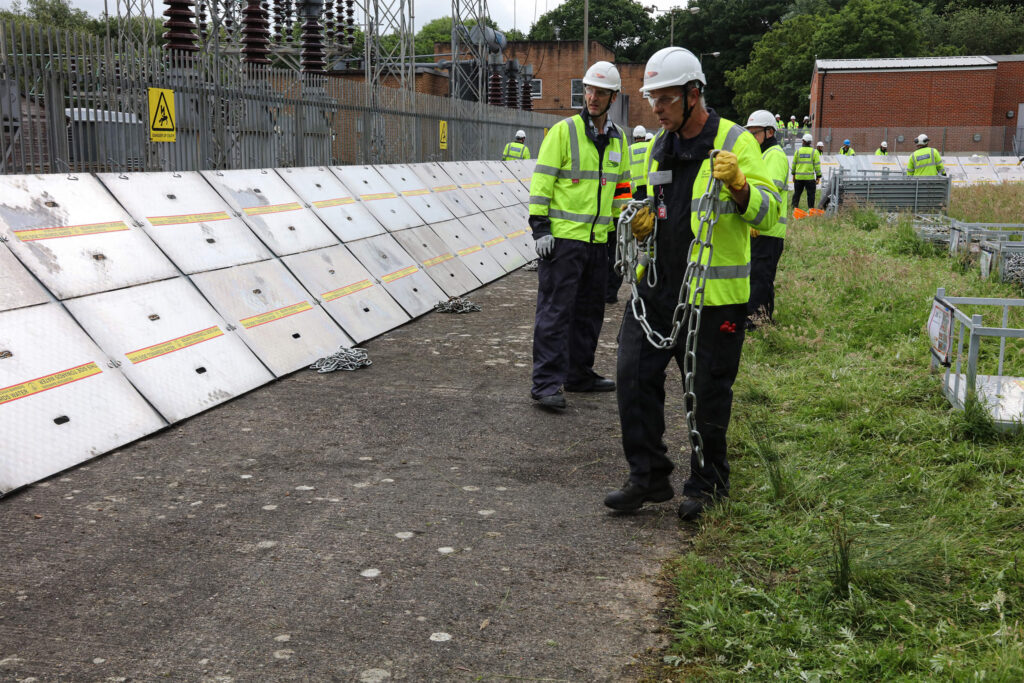 Case study
Three to four hours to protect a substation
How UK Power Networks works from an Environment Agency flood warning to a barrier around the site — and what its area manager says that actually takes.
Read moreFlood walls — common questions
What is a flood wall, and is a Geodesign flood wall permanent?
A flood wall is a barrier that holds floodwater away from what is behind it. Most flood walls are permanent structures in concrete or sheet piling, built once and left in place. A Geodesign flood wall is temporary: it is stored flat, raised by hand when a flood is forecast, and taken down afterwards, leaving nothing in the ground. The same stock can be moved between sites and reused for decades, which is why one set can protect several locations rather than one. See how the main types compare.
How do temporary flood barriers work?
A temporary flood barrier is put up before a flood and taken down afterwards, leaving nothing behind. Geodesign barriers use folding A-frame steel supports linked by connection rods, faced with panels (steel on Elemental and Industrial, chequer-plate aluminium on Heavy Duty) and a coated membrane. Punched metal collars under the bottom beam grip the ground, and the weight of the rising water presses on the membrane and anchors the barrier in place. No fill material, no tools and no ground fixings are needed.
What is the difference between temporary and demountable flood defences?
Flood risk authorities distinguish the two by what stays in the ground. Demountable defences rely on permanent foundations, sockets or guide posts installed in advance, with the closure panels fitted when a flood is forecast. Temporary defences have no permanent works at all and can be deployed anywhere the ground allows. Geodesign systems are temporary, which is why the same stock can be moved between sites and held centrally.
Do temporary flood barriers need fill material or ground anchoring?
Geodesign barriers need neither. There is no sand, aggregate or water filling to source, transport or clear away afterwards, and nothing is drilled or fixed into the ground. That removes the fill logistics that dominate mobilization time for sandbag and water-filled systems, and it means the same equipment is reused season after season.
Which certification applies to a Geodesign flood wall?
Nine models are FM Approved to ANSI/FM 2510-2020, an independent third-party certification held with FM Approvals under Approval Identification PR453294: Industrial P61 to P121 and Heavy Duty C122 to C245. Certification is granted per model and per dam height, so ask any supplier — including us — for the certificate covering the exact model and height you are specifying, rather than relying on a summary claim.
How high can a temporary flood wall protect?
The range covers 0.41 to 2.45 metres (1 ft 4 in to 8 ft) of dam height across three series: Elemental holds 0.41 to 0.61 m (1 ft 4 in to 2 ft), Industrial 0.61 to 1.22 m (2 to 4 ft) and Heavy Duty 1.22 to 2.45 m (4 to 8 ft). All three are compatible and can be combined along a single line, so a wall can step up and down to follow the ground and the depth it has to hold.
Looking for distributors in new markets
Geodesign sells through partners. If you supply flood protection, water infrastructure or emergency equipment in a market where we are not yet represented, we would like to hear from you. You get a certified, patented product with a 30-year track record, factory training for your crews, and technical support on live tenders.
Choose “Distributor inquiry” on the contact form and tell us which markets you cover.