Flood Protection: Risk, Readiness, Response.
Effective flood protection starts long before deployment — with risk assessment, warning time, and the right strategy for your site.
- Built around FM Global flood emergency planning principles
- Informed by FEMA floodproofing guidance
- 30+ years of real deployment experience


A practical flood protection framework — explore each topic below or read top to bottom.
What is flood protection?
Flood protection is part of a broader flood risk management portfolio. Understanding how the main system types relate to each other — and when each is appropriate — is the starting point for any flood protection strategy.
Flood protection within a broader risk management portfolio
Effective flood risk management typically combines multiple measures. FM Global and FEMA both identify the following elements as part of a complete portfolio.
FM Global guidance treats flood emergency response as a coordinated system — not a standalone product decision. Temporary and demountable barrier systems are recognized as critical components of site-level flood mitigation, particularly where permanent defenses are not feasible or where operational flexibility is required.
The three main types of flood protection system
All flood protection systems fall into one of three categories. The key difference is how much operational activity is required — and how much flexibility each offers.
01 — Temporary
Temporary
Fully deployed during event
Products wholly installed during a flood event and removed afterwards. Not tied to a fixed location — can be deployed wherever needed, making them ideal for incident response.
- Operational activityHigh
- FlexibilityHigh
- Lead-time requiredHigh
02 — Demountable
Demountable
Pre-installed foundations, closed during event
A moveable system fully pre-installed with permanent foundations, requiring operation during a flood event to close. Tied to a fixed location but faster to close than a purely temporary system.
- Operational activityMedium
- FlexibilityMedium
- Lead-time requiredMedium
03 — Permanent
Permanent
No operation required during event
A system fully in place at all times — technically the most reliable. No operation required during a flood event. Common examples include flood banks and flood walls.
- Operational activityNone
- FlexibilityLow
- Lead-time requiredNone
When is temporary protection the right choice?
FEMA P-936 frames temporary and demountable flood protection as active measures — appropriate where permanent passive protection is not feasible, and contingent on reliable warning time and organizational capacity to deploy.
Permanent protection is not feasible
Where cost, environmental impact, or visual impact of permanent works makes them impractical or unacceptable.
A reliable warning system is in place
Temporary systems only work if there is enough warning time to deploy them. Forecasting reliability is a prerequisite — not an optional extra.
Organizational capacity exists
Trained team, equipment, and protocols must be in place before a flood event — not improvised during one.
Flexibility across sites is needed
Temporary systems can be deployed at different locations and adapted to unplanned situations — making them ideal for incident response.
Assessing flood risk and site vulnerability
The right protection plan starts with understanding how water reaches your site, how much warning time you have, and how vulnerable it is if flooding occurs. Before choosing a system, you need a clear picture of the flood source, expected water level, likely warning time, water entry points, and operational consequences.
Site flood risk — real-world consequences
Understanding risk before selecting a protection system.
Water entry point assessment
Identifying vulnerabilities before an event.

Flood source & trigger events
Identify the likely source of flooding — river overflow, flash flooding, surface water, groundwater, or storm-driven runoff — and the weather events most likely to trigger it.

Warning time
Estimate how much notice you are likely to have before water reaches vulnerable areas. Some events allow days of preparation, others may provide only hours.

Expected depth, duration & protection height
Assess how high water may rise, how long it may remain, and the required protection height. Duration affects operational strategy and consequence severity — not just barrier selection.

Site surface, low points & weak points
Identify terrain irregularities, low-lying areas, and physical constraints that affect where a barrier line can be established.

Critical assets & business impacts
Identify the systems, equipment, spaces, and operations most at risk if flooding occurs — and what the business consequences would be if they fail.
Typical business impacts of site flooding
Based on FM Global’s flood emergency planning framework, these are the most common operational consequences of site flooding — and why identifying critical assets early is essential.
- Power disruptions
Flooding can knock out primary power systems, causing circuit failures, fires, or complete power failure.
- Equipment damage
Servers, hardware, and precision equipment can be irreversibly damaged by water exposure.
- Cooling and HVAC failure
Damage to cooling systems and air handling units leads to overheating and operational shutdown.
- Structural and environmental hazards
Floodwater carries contaminants. Humidity and condensation cause corrosion even where direct water exposure is avoided.
Flood Monitoring, Forecasting & Lead Time
Knowing your flood risk is only half the picture. The other half is time. Flood monitoring tells you when to act — lead time determines whether your chosen system can actually be deployed before water arrives.
Flood monitoring in practice
River gauges and early warning systems that inform activation decisions.
Deployment time is finite — lead time is not
Knowing how long mobilization takes determines when to trigger action.

Monitoring inputs
River gauges, NWS alerts, upstream rainfall data, and local site sensors help identify when action may be needed. Reliable monitoring combines multiple inputs — not just one.

Trigger thresholds
Pre-defined water levels or forecast probabilities that initiate action. Triggers must be set early enough to allow full mobilization before conditions make deployment unsafe.

Forecast uncertainty
All forecasts carry uncertainty. Short-range predictions are often more reliable, while earlier alerts give more time but less confidence. Plans should be built around the worst credible scenario.

Flood arrival time
How quickly water reaches your site after rainfall or an upstream trigger event. Steep urban catchments respond in hours; large river systems may give days.
Why flood protection systems fail in practice
A flood protection system has failed when it can no longer meet its pre-defined performance objective. Failure can be functional, structural, or operational — and temporary or demountable systems introduce an additional layer of risk, because they must be fully in place before flooding begins.
The system overtops, seeps, or outflanks.
Typically caused by flood levels higher than expected, inadequately sealed end details, or water passing over the lowest crest point.
The barrier or its support loses stability.
Collapse, overturning, sliding, piping, or foundation failure. With certified barriers correctly specified for the site, the least common failure mode in practice.
The barrier isn’t closed in time.
Forecasting, alerting, mobilization, or closure processes break down. FM Global identifies this as the critical risk for temporary and demountable systems.
Building a Flood Emergency Response Plan
A flood barrier is only one part of flood protection. A FERP defines who makes decisions, how monitoring triggers action, and what must happen before, during, and after a flood event. For sites relying on temporary or demountable protection, the plan is part of the protection system itself.

From plan to protection
A well-rehearsed FERP turns hours of preparation into minutes of coordinated action.
What is a FERP?
A Flood Emergency Response Plan is a site-specific operational document that defines the triggers, roles, procedures, and resources required to deploy flood protection before water reaches the site. It turns flood protection from a product into a system.
Core Components
Seven sections every FERP includes
-
01
Site flood hazard
Documented flood sources, expected levels, and critical protection heights for the site.
-
02
Authority to activate
Clearly named decision-makers with the authority to trigger response — and their designated backups.
-
03
Flood monitoring & triggers
Defined monitoring sources and specific water-level or forecast thresholds that initiate each phase of the plan.
-
04
Action plan & roles
Step-by-step deployment procedures with assigned roles, crew sizes, and timing for each task.
-
05
Facility shutdown procedures
Checklists for electrical, process, and operational shutdown to protect critical assets and personnel.
-
06
Recovery & restoration
Post-event procedures for inspection, cleanup, fire protection restoration, and return to operations.
-
07
Training & review cycle
Annual drills, post-event reviews, and scheduled updates to keep the plan operational over time.
Flood Action, Mobilization, and Recovery
A response plan only works if it can be executed under real conditions. Once trigger thresholds are reached, the site must mobilize the right people, move equipment into position, close the protection line, and recover safely once the event is over. Each phase has different constraints and different priorities.
Monitoring thresholds reached; warning issued; plan activated.
- Mobilize crew and deliver barrier equipment to staging areas
- Deploy protection line from highest-risk entry points outward
- Begin facility shutdown: electrical, process, critical assets
- Seal end connections and confirm protection line is complete
Water reaches the site; protection system is in full service.
- Continuous surveillance of barrier performance, water levels, and seepage
- Trained supervision of the protection line while in service
- Response to exceedance, damage, or unexpected site conditions
- Maintain site security, drainage, and communication with crew
Water recedes and conditions are safe for re-entry.
- Document site conditions and notify insurance carrier
- Remove barriers in controlled sequence, furthest from flow first
- Inspect and restore fire protection and critical systems
- Conduct post-event review and update the plan for next time
The full operational detail — mobilization, closure sequencing, and recovery.
Read the Flood Action Plan guideChoosing the right flood protection family
Choosing between Geodesign’s three product families — Elemental, Industrial, and Heavy Duty — is not about picking the highest-rated option. It is about matching the family to your required protection height, site conditions, deployment method, and operational capacity. Five questions usually point to the right family.
Part 1 · Decision Variables
Five factors that shape the right product for your site
Protection height
How much water must be held back? The required dam height is the first gate for product selection.
Site surface & geometry
Hard surfaces, corners, bends, wall attachments, and uneven ground each shape which system can follow the protection line.
Deployment speed & crew
How quickly must the barrier be in place — and with how many people? Compact systems deploy fast with small crews.
Storage & transport
Compact storage and organized logistics matter when the system must be ready between events and shipped to staging areas.
Severity of conditions
Waves, debris, overtopping, and deployment in water all demand a more robust barrier format.
Part 2 · Product Families
Three Geodesign product families for different profiles
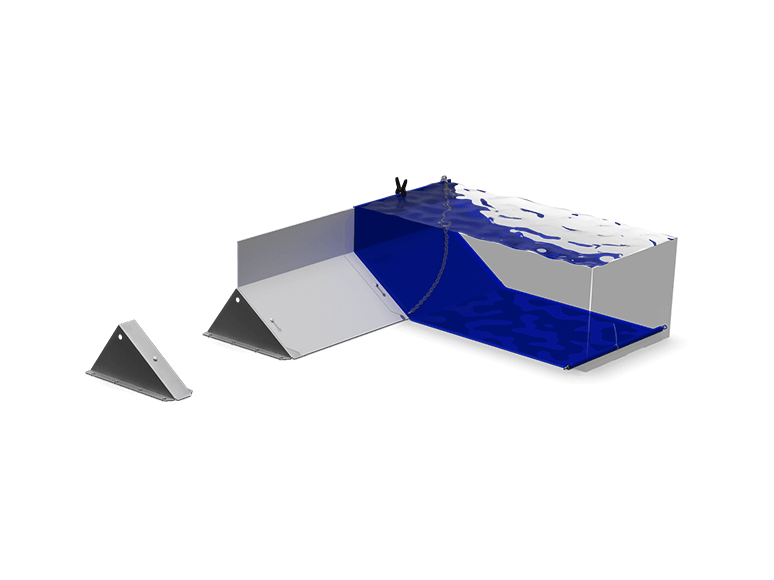
ELEMENTALFlood Barrier
Designed for smaller-scale applications where protection heights are modest and simplicity is a priority. Compact handling, fewer parts, straightforward setup.
Key fit
- Lower water levels
- Simpler site layouts
- Compact storage and handling
- Simpler handling with fewer parts
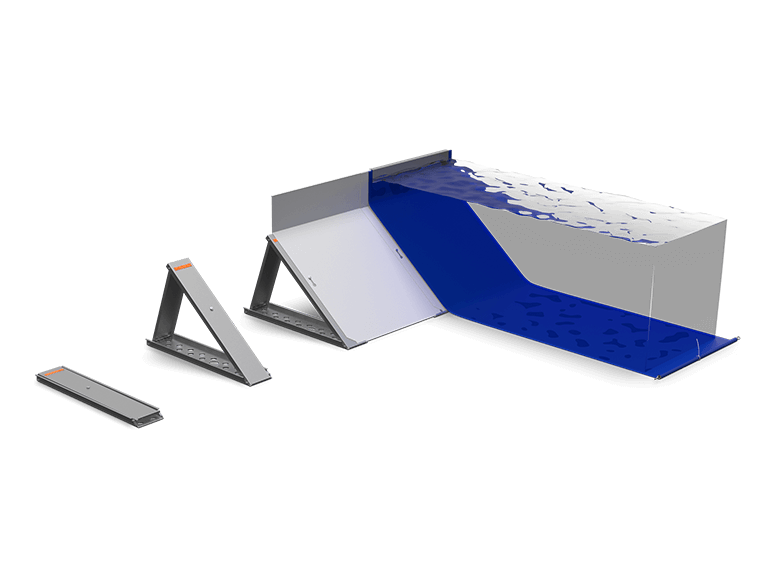
INDUSTRIALFlood Barrier
Designed for larger-scale protection where deployment speed, repeatability, logistics, and compatibility with site geometry are important. Well-suited to operational users who need rapid deployment across longer lines.
Key fit
- Protection heights up to roughly 3.3–4 ft
- Long barrier runs and perimeter applications
- Fast deployment and organized storage
- Corners, bends, wall attachments, uneven ground
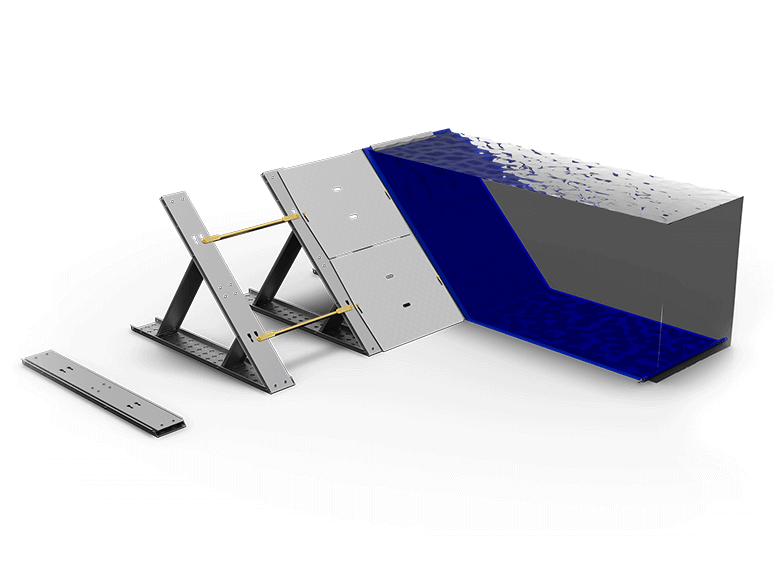
HEAVY DUTYFlood Barrier
Designed for perimeter applications where flood loads, debris, waves, overtopping, or complex site geometry demand a more robust barrier format. Supports structured deployment in challenging urban and utility environments.
Key fit
- Higher protection levels
- Waves, debris, overtopping, deployment in water
- Demanding urban and utility environments
- Adjustable sections, corners, wall attachments
Training, drills, and post-event review
A flood response plan that has never been practiced is not an operational plan — it is a document. Training, drills, and structured post-event review are what turn a FERP into a system that actually works when water arrives. This section covers the three training formats most sites use, and the review cycle that keeps the plan current over time.
Part 1 · Training Formats
Three training formats for different levels of readiness
Tabletop
Tabletop exercise
A scenario-based discussion walkthrough. The team sits around a table and talks through how they would respond to a realistic flood scenario — identifying gaps before they matter in the field.
Partial Drill
Partial deployment drill
A hands-on exercise where the crew assembles and positions a section of the barrier in a controlled setting. Tests equipment handling, crew coordination, and access routes without the full commitment of a complete dry run.
Full Dry Run
Full dry run
A complete simulated activation: trigger, call-out, mobilization, and full barrier deployment end to end. The most demanding format — and the only one that reveals how the full sequence actually performs under time pressure.
Part 2 · Continuous Improvement
The post-event review cycle
After every activation — real event, drill, or false alarm — the team follows a four-step cycle that keeps the FERP aligned with what actually happens on site. The loop is the point: every event makes the plan stronger.
Conduct
Hold the post-event review within two weeks. Cover what worked, what failed, and what was unexpected.
Document
Capture observations, timing data, crew feedback, and specific failures or near-misses in the event log.
Every event makes the plan stronger
Update plan
Revise triggers, roles, procedures, or equipment lists based on what was learned. Log the revision.
Train
Brief the team on what changed. Incorporate lessons into the next tabletop, drill, or dry run.
Where Geodesign fits
Flood protection is broader than any single product. But where a site has usable lead time, needs repeatable deployment, and benefits from modular perimeter protection rather than permanent civil works, Geodesign is built for exactly that part of the problem — and for more than the barrier line itself.
Part 1 · More than barrier units
What a working flood protection solution actually includes
Most perimeter protection plans involve more than the visible dam. Depending on the site, the system extends into storage, supporting hardware, and operational documentation. Geodesign supplies the full set — organized as three connected layers.
The components that physically close and seal the protection line
- Modular barrier sections sized to the protection height
- Corners, bends, and transitions for site geometry
- Wall attachments, end closures, and door openings
The elements that make the barrier line work under real conditions
- Purpose-built storage systems and on-site staging layout
- Drain blocking and backflow protection at known ingress points
- Pump integration and dewatering behind the protection line
The documentation and training that make deployment repeatable
- Deployment manuals and site-specific procedures
- Operator and crew training on the installed system
- Readiness planning, annual review, and post-event support
Part 2 · Where Geodesign is typically used
Sectors that rely on operationally deployable protection
The common thread across these sectors is usable lead time, perimeter-scale protection, and operational readiness. The specifics — height, surface, crew size, regulatory context — differ. The operational approach does not.
Municipal protection
Downtown areas, residential zones, and critical infrastructure corridors.
Data centers
Power rooms, generator yards, and cable vaults where water ingress is catastrophic.
Manufacturing
Production lines, warehouses, and loading docks where downtime carries heavy cost.
Utilities
Substations, water treatment plants, and control buildings where continuity is regulated.
Transportation
Airports, rail yards, and access tunnels where shutdown has cascading effects.
Common questions from facility and flood response teams
Practical answers to the questions we hear most often during site assessments and procurement. If your question is not here, most specifics come down to site conditions, protection height, and response plan — and are best answered against a site walkthrough.
How much lead time does temporary flood protection need?
Deployment time depends on barrier length, height, site complexity, and crew size. A typical 300–650 ft perimeter at 2.5–3.3 ft height deploys in a few hours with a trained crew — significantly faster than sandbag equivalents.
The operational question is not “how fast can it deploy” but whether Available Lead Time > Deployment Time + Safety Margin. If the forecast gives you 18 hours of warning and deployment takes 4, the site has usable margin. If the forecast gives 3 hours, the site needs a different strategy — pre-staged components, permanent defenses, or a hybrid.
How do Geodesign barriers compare to sandbags?
Sandbags remain useful for small, localized protection or as a supplement at hard-to-reach points. For perimeter-scale protection, modular barriers deploy faster, require fewer people, seal more reliably against moving water, and are reusable across multiple events.
A 300 ft barrier line that takes four people a few hours to deploy would require dozens of crew and thousands of bags to match with sandbags — often more time than the forecast allows.
How many people are needed to deploy a flood barrier?
Crew size scales with the product family and the length of the line. As a rough guide: a short Elemental deployment can be handled by 2 people; a longer Industrial line typically runs with 4–6; Heavy Duty deployments in more demanding conditions often use 6–8.
The more important planning question is not the minimum crew — it is whether you have that crew trained, available, and on-site within the available lead time.
Can flood barriers work on uneven ground, soft soil, or paved surfaces?
Yes, on all three — with product family differences. Elemental and Industrial systems handle asphalt, concrete, compacted gravel, grass, and moderately uneven ground. Heavy Duty handles the most demanding surface conditions, including deployment in standing water.
Surface type, slope, and ground bearing are part of the site assessment. A walkthrough identifies where transitions, corner pieces, or wall attachments are needed to close the protection line around real site geometry.
Can the same barriers be used across multiple flood events?
Yes. Geodesign systems are designed for repeat deployment — reusability is a core part of the operational case. After an event, components are cleaned, inspected, and returned to organized storage ready for the next deployment.
Expected service life depends on the product family, frequency of use, and storage conditions.
What happens if floodwater exceeds the barrier height?
Honest answer: overtopping is a real scenario and the FERP should plan for it. No temporary barrier protects beyond its design height, and underestimating the design flood event is one of the most common planning errors we see.
The response is twofold. First, select the protection height against a conservatively defined design flood — including freeboard margin for wave action, wind setup, and forecast uncertainty. Second, Heavy Duty systems are specifically engineered to tolerate overtopping without structural failure, where site conditions warrant that capability.
What third-party testing or certifications do Geodesign barriers have?
For the US market, Geodesign barrier systems are FM Approved and certified to ANSI/FM 2510 — the primary performance standard for flood mitigation equipment recognized by FM Global. Products have also been tested by the US Army Corps of Engineers (USACE) under independent hydraulic performance protocols.
Does Geodesign integrate with an existing flood response plan?
Yes. If the site already has a Flood Emergency Response Plan, the barrier system is integrated into existing trigger thresholds, crew assignments, and deployment sequencing rather than replacing the plan.
If the site does not yet have a FERP, Geodesign provides starter templates, deployment documentation, and training support to help build one around the installed system.
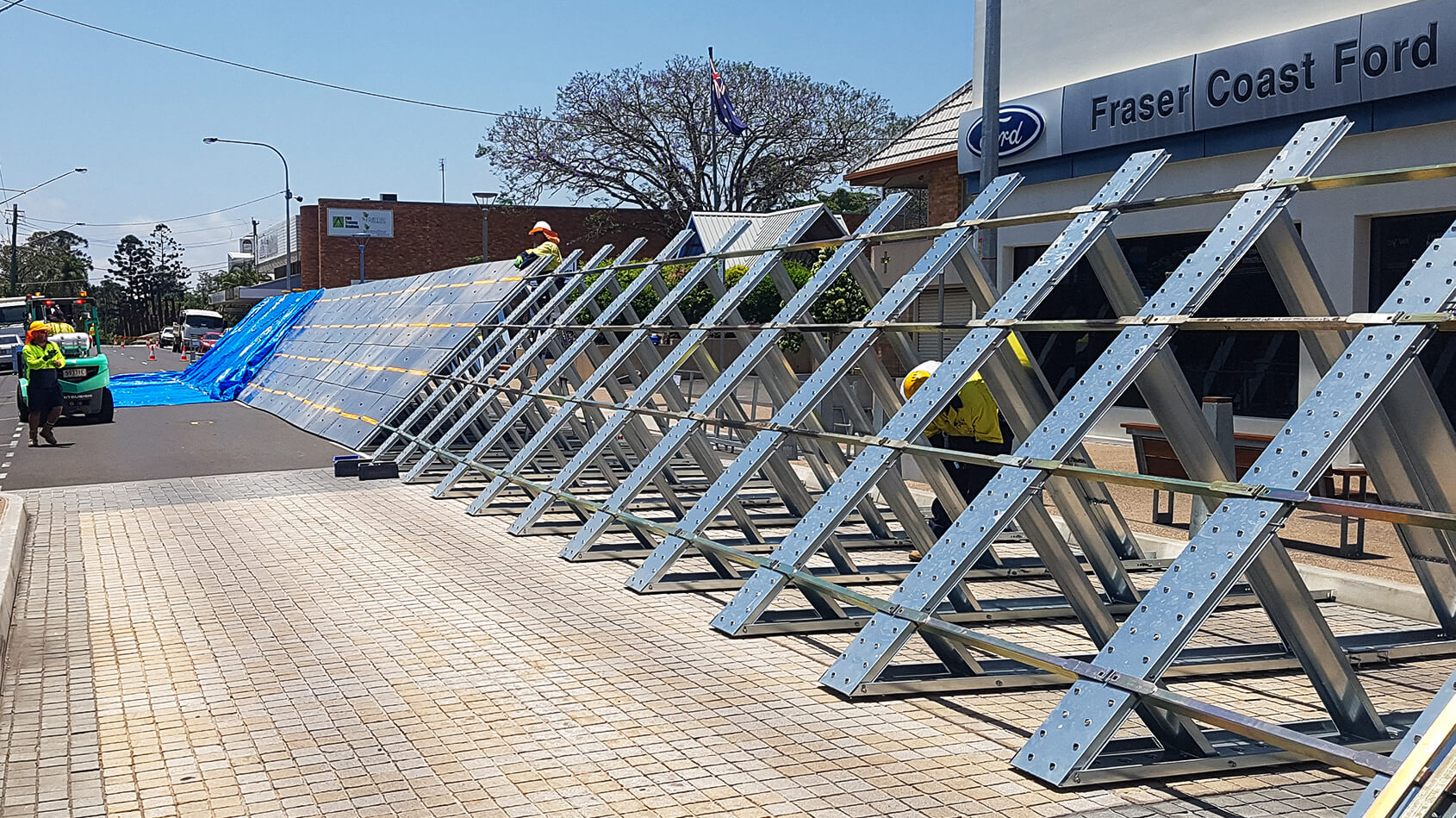
Ready to Protect Your Site?
Tell us about your project and we'll recommend the right barrier approach, walk through your site conditions, and respond with a tailored recommendation.
-
FM Approved systemCertified to ANSI/FM 2510 — verified performance under demanding flood conditions.
-
Response within 24 hoursA Geodesign specialist will review your site and respond with a tailored recommendation.
-
Trusted by Exxon Mobil, Duke Energy, Ameren & SonocoDeployed across industrial, utility, municipal, and rail sites in 24 countries.
-
30+ years in the field538,000+ linear ft deployed globally across municipal, commercial, and industrial sites.


